Lipstick is reapplied more often than almost any other cosmetic; after coffee, meals, and every lip-lick in between, a portion of the formula ends up ingested over the course of a day. That’s exactly why ingredient quality matters more here than on almost any other part of the face.
It’s also why “organic lipstick” has become one of the most overused claims in beauty. Nothing in the law prevents a brand from calling a product “natural” or “organic-inspired,” even if it contains little to no certified organic content. This guide skips the usual brand-list format. Instead, it teaches you to evaluate any lipstick yourself by the wax, oil, pigment, and preservative system so you can choose with confidence in any store, from any brand.
What Makes a Lipstick Truly Organic?
“Organic” is an agricultural term before it’s a beauty one. A legitimate claim traces back to a real certification auditing the percentage of organic content in the formula:
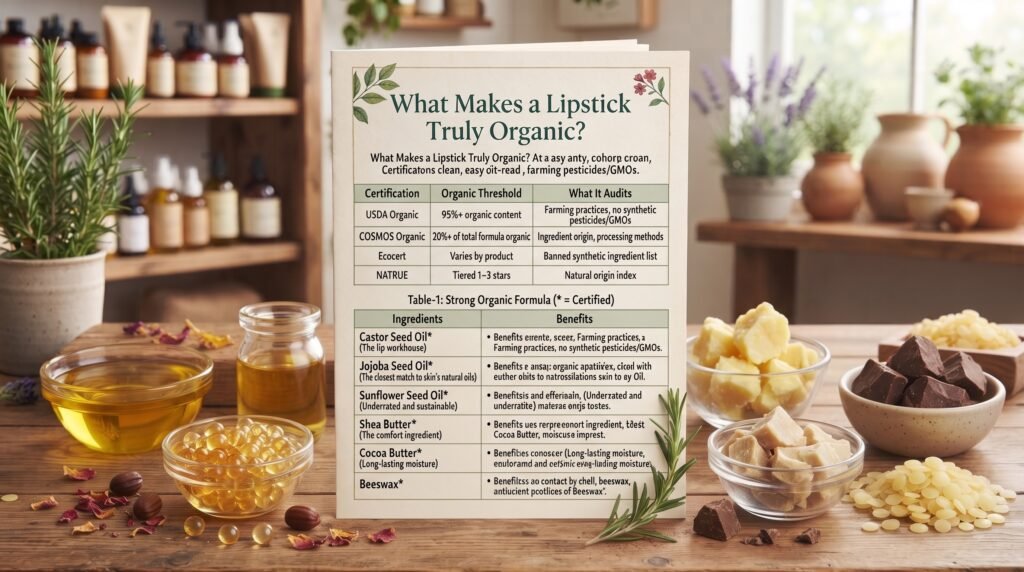
| Certification | Organic Threshold | What It Audits |
| USDA Organic | 95%+ organic content | Farming practices, no synthetic pesticides/GMOs |
| COSMOS Organic | 20%+ of total formula organic | Ingredient origin, processing methods |
| Ecocert | Varies by product | Banned synthetic ingredient list |
| NATRUE | Tiered 1–3 stars | Natural origin index |
Strong Organic Formula (* = Certified)
| Ingredients | Benefits |
| Castor Seed Oil* (The lip workhouse) | Creates a smooth, glossy finish Helps pigments disperse evenly Improves color payoff Gives the lipstick its characteristic “slip” Best for dry lips, pigmented lips, and anyone who likes a creamy texture |
| Jojoba Seed Oil* (The closest match to skin’s natural oils) | Lightweight and non-greasy Excellent for sensitive lips Highly stable (less likely to oxidize) Helps maintain the lip barrier Best for sensitive lips and mature lips |
| Sunflower Seed Oil* (Underrated and sustainable) | Rich in vitamin E Lightweight hydration Affordable and environmentally friendly Works well in hot climates Best for everyday wear and sustainable beauty shoppers |
| Shea Butter* (The comfort ingredient) | Deeply nourishing Reduces the feeling of tightness Ideal for cracked or peeling lips Best for winter use and very dry lips |
| Cocoa Butter* (Long-lasting moisture) | Creates a protective barrier Gives a richer, more luxurious feel Helps prevent moisture loss Best for very dry lips, overnight lip treatments, and satin-finish lipsticks |
| Beeswax* | Creamy texture Excellent moisture retention Natural subtle shine Flexible and comfortable on the lips |
Where Does Lipstick Color Come From?
Every lipstick, whether it’s labeled organic, natural, vegan, or clean, relies on pigments to create color. In organic formulations, pigments generally come from two main sources:
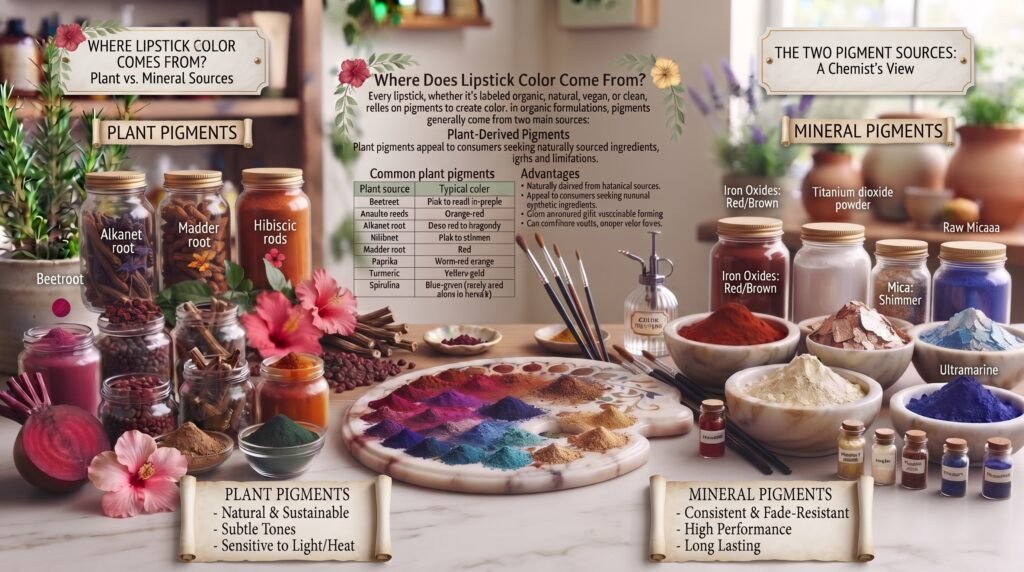
1. Plant-Derived Pigments
Plant pigments appeal to consumers seeking naturally sourced ingredients, but they have both strengths and limitations.
Common plant pigments
| Plant Source | Typical Color |
|---|---|
| Beetroot | Pink to reddish-purple |
| Annatto seeds | Orange-red |
| Alkanet root | Deep red to burgundy |
| Hibiscus | Pink to crimson |
| Madder root | Red |
| Paprika | Warm red-orange |
| Turmeric | Yellow-gold |
| Spirulina | Blue-green (rarely used alone in lipstick) |
Advantages
- Naturally derived from botanical sources.
- Appeal to consumers seeking minimal synthetic ingredients.
- Often associated with sustainable farming practices.
- Can contribute subtle, unique color tones.
Limitations
- Less light stable.
- More prone to fading.
- Sensitive to heat and oxidation.
- Less consistent between harvests.
2. Mineral-Derived Pigments
Most high-performance organic lipsticks rely on cosmetic-grade mineral pigments.
Common mineral pigments
| Pigment | Purpose |
| Iron oxides | Red, brown, yellow, black shades |
| Titanium dioxide | Adds opacity and lightness |
| Mica | Creates shimmer and luminosity |
| Ultramarines | Blue and violet tones |
Why cosmetic chemists prefer them
Mineral pigments offer:
- Excellent color consistency.
- Superior fade resistance.
- High heat stability.
- Better wear time.
- Reliable batch-to-batch performance.
Why Organic Lipsticks Still Need Preservatives
One of the biggest myths in clean beauty is that preservatives are unnecessary or harmful. In reality, preservatives play an important role in maintaining product quality and consumer safety.
Although traditional bullet lipsticks contain little or no water, which reduces the risk of bacterial growth, the botanical oils and plant extracts they contain can still degrade over time. Lip glosses, liquid lipsticks, and tinted balms often require more robust preservation systems because they may contain water or ingredients that increase the risk of microbial contamination.
It’s also important to distinguish between antioxidants, which slow the oxidation of oils, and preservatives, which help control the growth of microorganisms in formulas where that risk exists.
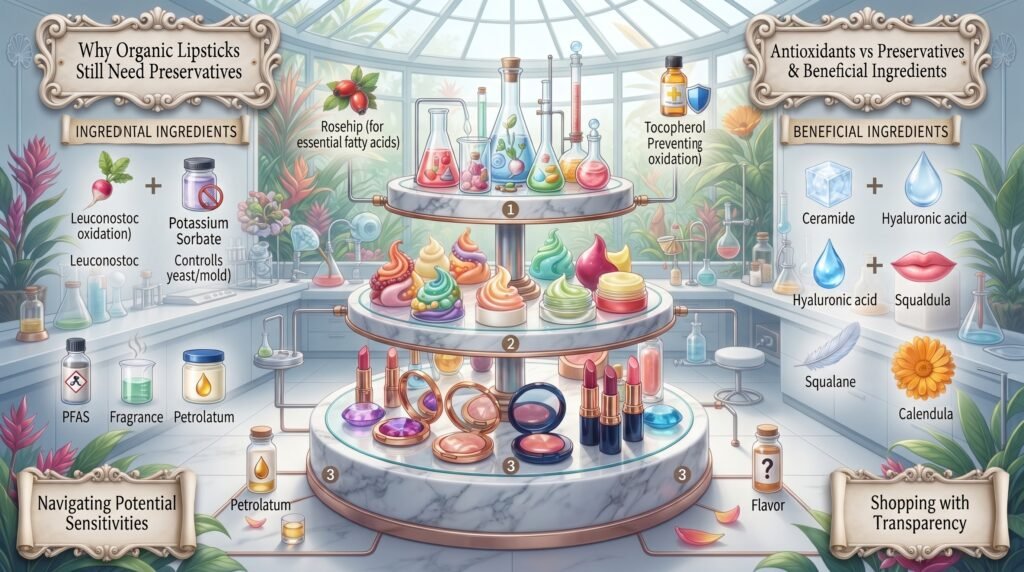
Antioxidants vs Preservatives
| Ingredient | Main role |
| Tocopherol (Vitamin E) | Helps prevent oils from oxidizing |
| Rosemary extract | Supports oxidation stability |
| Potassium sorbate | Helps control yeast and mold in suitable formulas |
| Sodium benzoate | Helps inhibit microbial growth in acidic systems |
| Leuconostoc/Radish Root Ferment Filtrate | Ferment-derived preservation support |
| Lactobacillus Ferment | Helps support microbial stability |
| Glyceryl Caprylate | Multifunctional ingredient with preservation support |
| Caprylyl Glycol | Humectant with preservative-boosting properties |
Ingredients Worth Looking For
Beyond oils and waxes, several ingredients can improve lip comfort and support a healthier-looking lip barrier.
| Ingredient | Benefits |
| Ceramides | Help reinforce the lip barrier and reduce moisture loss |
| Hyaluronic acid | Attracts moisture for a plumper appearance |
| Squalane | Lightweight hydration without a greasy feel |
| Calendula extract | Helps soothe dry or irritated lips |
| Chamomile extract | Calming for sensitive lips |
| Rosehip oil | Rich in essential fatty acids and antioxidants |
| Sea buckthorn oil | Provides carotenoids and nourishing lipids |
| Avocado oil | Softens and conditions dry lips |
| Pomegranate oil | Rich in antioxidants that support skin conditioning |
Ingredients to Approach with Caution
Polyfluoroalkyl Substances (PFAS)
Some long-wear cosmetic products have been found to contain PFAS, either intentionally or as impurities. If you prefer to minimize exposure, choose brands that clearly state they do not intentionally add PFAS and that provide transparency about ingredient testing.
Synthetic fragrance
Fragrance is one of the most common triggers for cosmetic sensitivity. If your lips frequently become dry, itchy, or irritated, consider fragrance-free options or products scented only with clearly identified botanical ingredients.
Petroleum-derived ingredients
Ingredients such as petrolatum and mineral oil are considered safe for cosmetic use by many regulatory authorities and can be effective occlusives. However, some consumers prefer plant-based alternatives for sustainability or personal preference. Rather than viewing these ingredients as inherently unsafe, consider whether they align with your priorities.
Undisclosed flavor blends
If a product lists only “flavor” or “aroma” without additional detail, consumers with known sensitivities may prefer brands that provide more transparent ingredient information.
Quick Formula Comparison Guide
| Lip Type | Best Formula | Why It Works | Avoid |
| Dry lips | Cream or Balm Stick | Rich in oils and butters to reduce moisture loss | Ultra-matte formulas |
| Cracked lips | Tinted Balm | Gentle, hydrating, comfortable | Long-wear matte lipstick |
| Sensitive lips | Fragrance-free Cream | Fewer potential irritants | Strong fragrances or essential oils if sensitive |
| Pigmented lips | Satin or Cream | Better opacity for even color | Sheer tints if full coverage is desired |
| Mature lips | Satin Finish | Doesn’t emphasize fine lines as much as matte | Dry matte formulas |
| Thin lips | Gloss or Satin | Reflects light for a fuller appearance | Dark, flat matte shades |
| Combination lips | Cream Satin | Balances hydration and wear time | Extremely drying formulas |
Organic Lipstick Buying Decision Tree
Dry lips → Choose cream or balm lipstick with beeswax, castor oil, and shea butter.
Vegan products → Look for candelilla wax or carnauba wax instead of beeswax.
Long-lasting color → Choose mineral pigments combined with carnauba or candelilla wax.
Sensitive lips → Select fragrance-free formulas with jojoba oil and minimal ingredients.
Sustainability matters most → Prioritize refillable packaging, responsibly sourced ingredients, cruelty-free certifications, and transparent supply chains.
How to Read a Lipstick Ingredient Label
Many shoppers only read the claims on the front of the package. The ingredient list provides much more useful information.
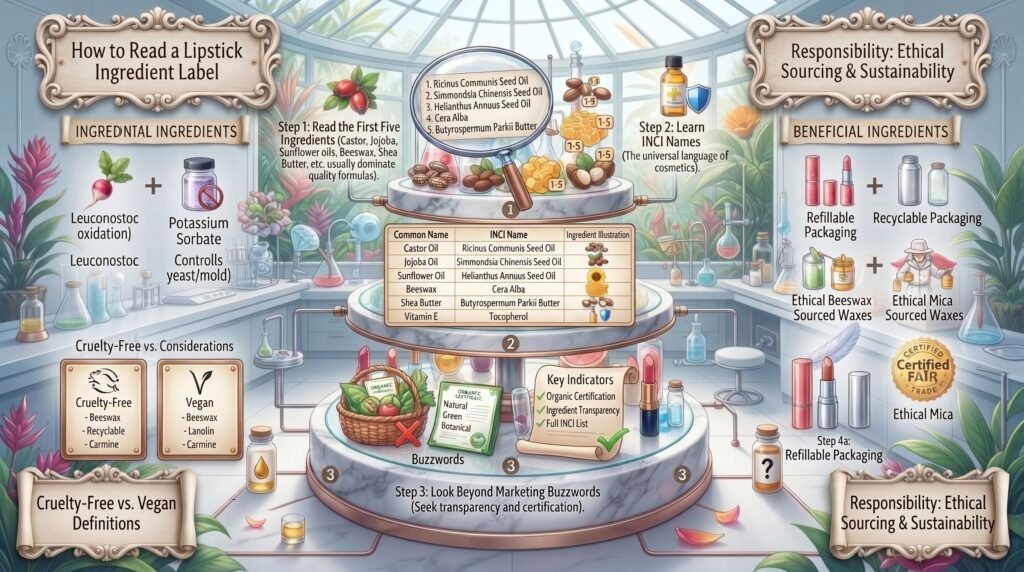
Step 1: Read the First Five Ingredients
The first ingredients usually make up most of the formula.
A quality organic lipstick often begins with ingredients such as:
- Castor oil
- Jojoba oil
- Sunflower oil
- Beeswax
- Candelilla wax
- Shea butter
If these appear near the end of the list, they are present in much smaller amounts.
Step 2: Learn Common INCI Names
Cosmetics use the International Nomenclature of Cosmetic Ingredients (INCI).
| Common Name | INCI Name |
| Castor oil | Ricinus Communis Seed Oil |
| Jojoba oil | Simmondsia Chinensis Seed Oil |
| Sunflower oil | Helianthus Annuus Seed Oil |
| Beeswax | Cera Alba |
| Shea butter | Butyrospermum Parkii Butter |
| Vitamin E | Tocopherol |
Step 3: Don’t Be Misled by Marketing Buzzwords
These terms sound appealing but may not tell you much about the formulation:
- “Natural”
- “Green”
- “Botanical”
- “Eco-friendly”
- “Pure”
Instead, look for:
- Ingredient transparency
- Organic certification
- Full INCI list
- Clearly identified botanical oils
- Reputable manufacturing standards
Step 4: Sustainability Considerations
A lipstick may contain excellent ingredients but still have a significant environmental footprint. Looking beyond the formula can help you make more sustainable purchasing decisions.
Refillable Packaging
- Reduces plastic waste
- Extends the life of the lipstick case
- Lowers material consumption over time
Recyclable Packaging
- Aluminum cases
- Glass components (where practical)
- Recyclable cardboard cartons
- Minimal plastic packaging
Responsibly Sourced Waxes
- Beeswax from ethical beekeeping practices
- Candelilla wax harvested responsibly to protect native ecosystems
- Sustainably managed carnauba palm production
Ethical Mica
- Mica creates shimmer and luminosity in many lipsticks.
- Look for brands that participate in responsible sourcing initiatives and audit their supply chains to help reduce the risk of child labor and improve working conditions.
Palm Oil Considerations
- Responsibly sourced palm derivatives
- Certified sustainable palm oil
- Clearly disclosed sourcing information
Cruelty-Free vs Vegan
| Cruelty-Free | Vegan |
| Product was not tested on animals where certified | Contains no animal-derived ingredients |
| May still contain beeswax | Does not contain beeswax, lanolin, or carmine |
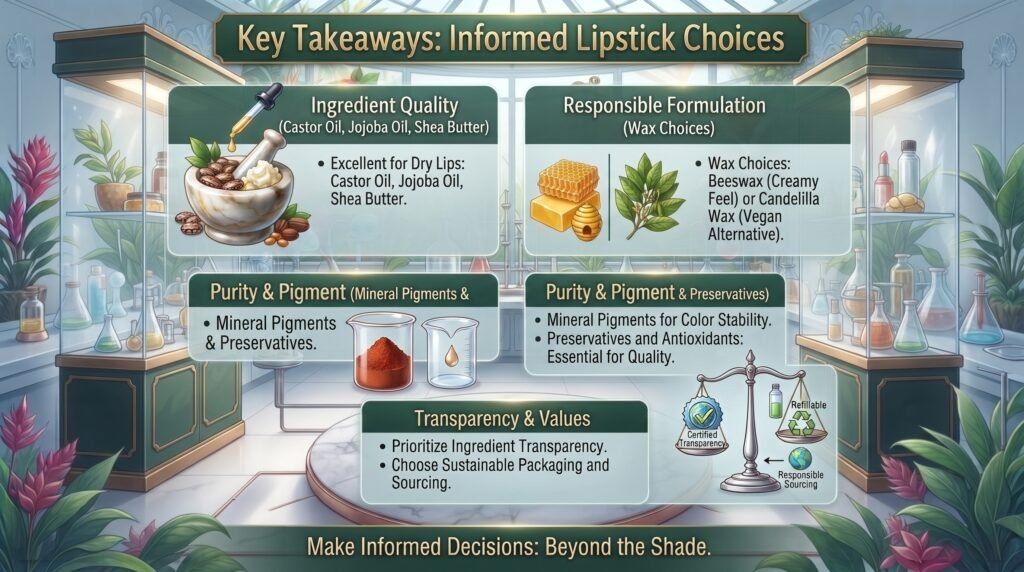
Key Takeaways
- Check certifications, not just marketing claims.
- Castor oil, jojoba oil, and shea butter are excellent choices for dry lips.
- Beeswax creates a creamy feel, while candelilla wax is a popular vegan alternative.
- Mineral pigments generally provide the most stable and long-lasting color.
- Preservatives and antioxidants serve different purposes—both can contribute to product quality when used appropriately.
- Choose your lipstick based on your lip type, not just the shade.
- Ingredient transparency is one of the strongest indicators of a trustworthy brand.
- Sustainable packaging and responsible ingredient sourcing add environmental value beyond the formula itself.
Final Thoughts
Choosing an organic lipstick involves more than selecting a beautiful shade. The best products combine thoughtfully sourced ingredients, effective formulation, transparent labeling, and responsible manufacturing practices. Rather than relying on marketing terms like “natural” or “clean,” focus on what the ingredient list, certifications, and brand transparency reveal.
A high-quality organic lipstick should feel comfortable, provide reliable color, support your lip barrier, and reflect your priorities—whether that’s vegan ingredients, sensitive-skin compatibility, long-lasting wear, or sustainability. By understanding the role of oils, waxes, pigments, antioxidants, and certifications, you can shop with confidence and choose products based on evidence rather than advertising.
Before buying your next lipstick, spend one extra minute reading the ingredient label. That simple habit can help you find a formula that’s not only flattering but also well-suited to your lips, your lifestyle, and your values.
Related Guides
Organic Concealer Guide: Can One Fix Both Under-Eyes and Blemishes?
Organic Serums Decoded: Which Natural Actives Are Actually Stable?
Best Certified Organic Korean Skincare-Makeup Hybrids [2026 Guide]
Organic Foundation Guide 2026: Find Your Perfect Match
10 Proven Ways to Reduce Your AC Energy Bills in the GCC

10 Best Passive Cooling Techniques for GCC Homes

Excellent guide! The ingredient-based approach makes it much easier to choose a safe and high-quality organic lipstick.