K-beauty is famous for glowing skin, innovative textures, botanical ingredients, cushions, tints, and skincare-inspired makeup. But there is an important distinction that gets lost in many “clean Korean beauty” lists:
A Korean cosmetic can be natural, vegan, clean, botanical, or skincare-infused without being certified organic. That difference matters if you are specifically looking for cosmetics backed by an independent organic standard.
Certified Korean organic makeup is still a relatively small niche. After checking product-level certification information rather than relying on brand marketing, a few products stand out particularly from REASONOR and SIORIS.
This guide focuses on those verified examples and explains how to choose them based on performance, ingredients, skin needs, climate, and sustainability.
What Is a Korean Skincare-Makeup Hybrid?
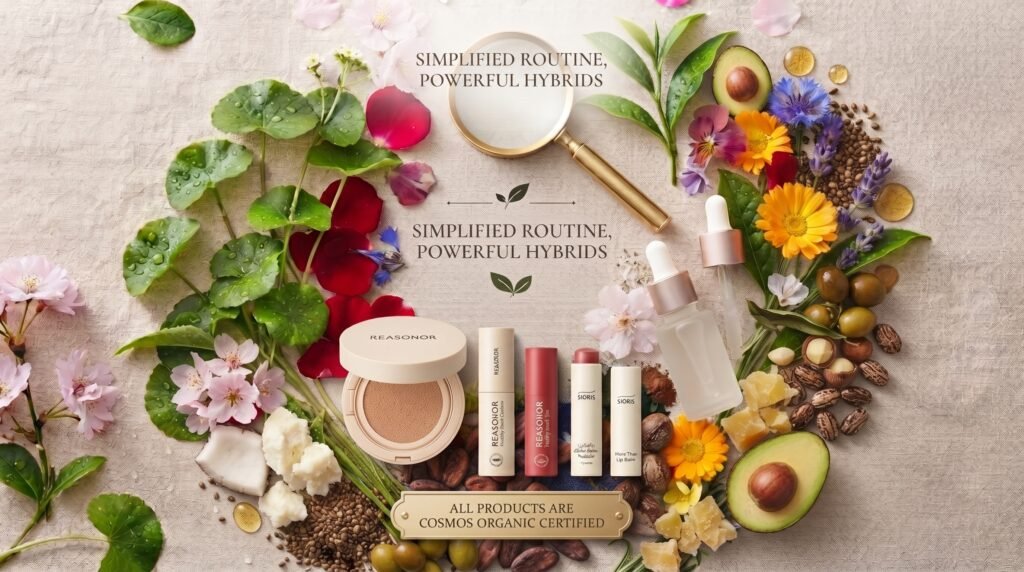
A skincare-makeup hybrid is a cosmetic designed to provide both a makeup function and a skin-care-oriented function.
Examples include:
- Cushion foundations with skin-conditioning ingredients
- Tinted lip balms
- Lip tints with conditioning ingredients
- BB creams
- Tinted moisturizers
- Makeup products designed around botanical or nourishing ingredients
The attraction is simple: instead of using many separate products, one product may perform more than one job. But “skincare-infused” does not automatically mean organic.
A product containing centella asiatica, green tea, rice extract, ginseng, plant oils, or other botanical ingredients is not automatically a certified-organic cosmetic. That is why certification must be checked at the finished-product level.
Organic, Natural, Clean and Vegan Are Not the Same
Beauty marketing frequently uses these terms together, even though they describe different things.
| Term | What It Generally Tells You |
| Certified organic | The finished product has been assessed against a recognized organic cosmetic standard |
| Natural | The product meets a defined natural-cosmetic standard, depending on the certification |
| Clean beauty | Usually refers to a brand’s ingredient-selection philosophy |
| Vegan | No animal-derived ingredients according to the relevant standard/policy |
| Cruelty-free | Relates to animal-testing practices |
| Botanical | Contains plant-derived ingredients |
| Skincare-infused | Contains ingredients associated with skin conditioning or care |
The most important distinction is between organic and natural. COSMOS, one of the major international cosmetic certification standards, has separate COSMOS ORGANIC and COSMOS NATURAL designations. A product being natural does not automatically make it organic. Never treat “natural,” “clean,” or “contains organic ingredients” as proof that the finished product is certified organic.
How We Verified the Products
For this guide, the strongest evidence comes from the COSMOS certified-products directory, supplemented by current official brand information.
This is important because a brand can have:
- Certified-organic products
- Certified-natural products
- Conventional products
all within the same portfolio.
Therefore, certification should be checked for the specific product and version, not simply the brand.
This stricter approach produces a shorter list—but a much more trustworthy one.
4 Certified-Organic Korean Products Worth Knowing
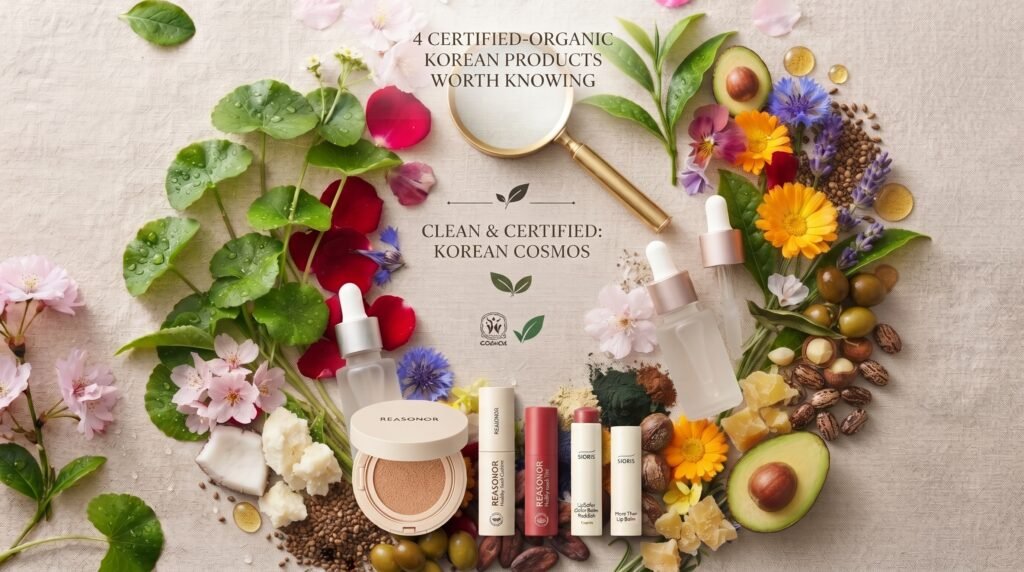
1. REASONOR Healthy Touch Cushion
Best for: Certified-organic Korean complexion makeup. REASONOR’s Healthy Touch Cushion is one of the strongest matches for anyone specifically searching for a certified-organic Korean makeup product.
The COSMOS directory currently lists three Healthy Touch Cushion shades as ORGANIC:
- 01 Sunny White
- 21 Pure Vanilla
- 23 Natural Beige
The products are listed with Control Union Korea as the certifier. The brand’s current Korean store also features the Healthy Touch Cushion and lists it as SPF50+ PA++++.
Why it stands out
The cushion format fits naturally into the Korean makeup philosophy of combining complexion coverage with a more skincare-oriented routine.
It offers:
- Cushion application
- Portable format
- Everyday complexion coverage
- Certified-organic status
- Three currently verified shades
Main limitation
Shade range.
Three verified shades are not enough for a genuinely inclusive complexion range.
If none matches your skin tone, certification should not persuade you to compromise on shade.
2. REASONOR Healthy Touch Tint
Best for: Certified-organic Korean lip color. REASONOR’s Healthy Touch Tint is another unusually strong example.
The COSMOS directory currently lists four shades as ORGANIC:
- 01 Punch Pink
- 02 Ruby Cherry
- 03 Glam Red
- 04 Crush Berry
They are also associated with Control Union Korea certification. The product is designed as a lip tint rather than a conventional opaque lipstick.
Why it is interesting
A tint can be useful for consumers who want:
- Lightweight lip color
- A simpler makeup routine
- A less bulky product than traditional lipstick
- Several color options within a certified-organic range
Current product information identifies the tint as a lip stain/lip makeup product.
Keep expectations realistic
A lip tint should not automatically be expected to provide the opacity of a traditional lipstick.
Certification tells you about the product standard—not how strongly the pigment will appear on every person’s lips.
3. SIORIS LipSafer Color Balm Reddish
Best for: Color + lip care. SIORIS offers perhaps the clearest example of the skincare-makeup hybrid concept. Its LipSafer Color Balm Reddish is listed in the COSMOS directory as ORGANIC, with Control Union Korea identified as the certifier.
Instead of being purely a lipstick or purely a treatment balm, it occupies the middle ground: lip color + conditioning.
The current SIORIS product information describes the product as a nourishing color balm and reports a 95% organic index and 100% natural index.
Why minimalists may like it
A color balm can potentially reduce the need for separate everyday lip products. That does not automatically make it more sustainable, but if one product genuinely replaces two products that you would otherwise purchase, it can support a simpler routine.
Best suited to
- Natural-looking lip color
- Everyday makeup
- Consumers who dislike heavy lipstick
- People who want color and lip conditioning together
4. SIORIS More Than Lip Balm
Best for: Organic-first minimalist lip care. SIORIS More Than Lip Balm is more skincare-oriented than the previous products.
The COSMOS directory lists it as ORGANIC, with Control Union Korea as the certifier.
Current product information highlights a rich combination of plant oils, butters and waxes, including ingredients such as:
- Perilla seed oil
- Coconut oil
- Shea butter
- Olive oil
- Macadamia seed oil
- Castor seed oil
- Beeswax
- Candelilla wax
- Avocado oil
The product information reports a 93.4% organic ingredient content.
Why it belongs in this guide
It demonstrates that the skincare-makeup hybrid concept does not always require strong color. For someone who wants a simpler beauty routine, a high-quality lip-care product can be more useful than collecting multiple glosses, treatments, and balms.
Quick Comparison
| Product | Category | Certification | Best Use |
| REASONOR Healthy Touch Cushion | Cushion foundation | COSMOS ORGANIC | Complexion makeup |
| REASONOR Healthy Touch Tint | Lip tint | COSMOS ORGANIC | Everyday lip color |
| SIORIS LipSafer Color Balm Reddish | Color balm | COSMOS ORGANIC | Lip color + care |
| SIORIS More Than Lip Balm | Lip balm | COSMOS ORGANIC | Organic lip care |
The certification status above is based on the current COSMOS product directory.
What About Other Famous Korean Beauty Brands?
This is where many online articles become misleading.
A Korean brand may have:
- Organic-certified skincare
- Natural-certified products
- Vegan products
- Botanical formulas
- “Clean” marketing
without having certified-organic makeup.
For example, WHAMISA is strongly associated with organic and fermented Korean skincare, but its strongest certified-organic identity is in skincare rather than makeup hybrids. It should therefore not be presented as evidence that every Korean cosmetic is organic.
Natural Origin provides another useful lesson. Its COSMOS listings include certified-organic skincare, but its Color Lip Balm Rose has been listed as NATURAL rather than ORGANIC. A brand can be certified organic without every product from that brand being certified organic. Always check the individual product.
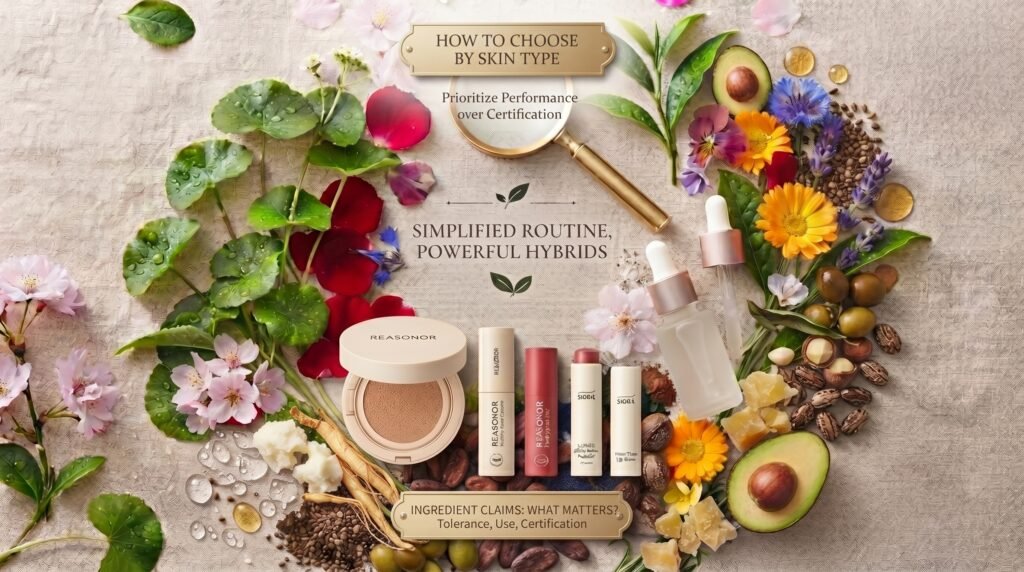
How to Choose by Skin Type
Certification should never replace normal cosmetic decision-making.
Dry skin
Look for comfortable, conditioning textures and avoid unnecessarily mattifying formulas. For lips, a richer balm such as SIORIS More Than Lip Balm may make more sense than a highly pigmented, drying lip product.
Oily or combination skin
Focus more heavily on:
- Lightweight application
- Thin layers
- Shine control
- Long-wear performance
Do not assume that an organic product will automatically have the finish you want.
Sensitive skin
Organic does not mean universally suitable for sensitive skin. Natural fragrances and essential oils can still cause problems for some people. Read the complete ingredient list and avoid ingredients you already know your skin does not tolerate.
Normal skin
You have the widest range of options, but the same rule applies: choose according to performance and preference, not the organic label alone.
Ingredient Claims: What Actually Matters?
K-beauty products often feature ingredients such as:
- Centella asiatica
- Green tea
- Rice-derived ingredients
- Ginseng
- Plant oils
- Shea butter
- Hyaluronic acid
These ingredients can have legitimate cosmetic functions. But an ingredient being popular or plant-derived does not prove that the finished product is certified organic.
Similarly, “synthetic” does not automatically mean unsafe.
A sensible evaluation considers:
- The actual ingredient
- Its concentration and formulation role
- Your skin’s tolerance
- The product’s intended use
- The relevant certification or safety information
Avoid simplistic claims such as “chemical-free.” Everything in a cosmetic is made of chemicals, including water and plant-derived ingredients.
What About SPF Makeup?
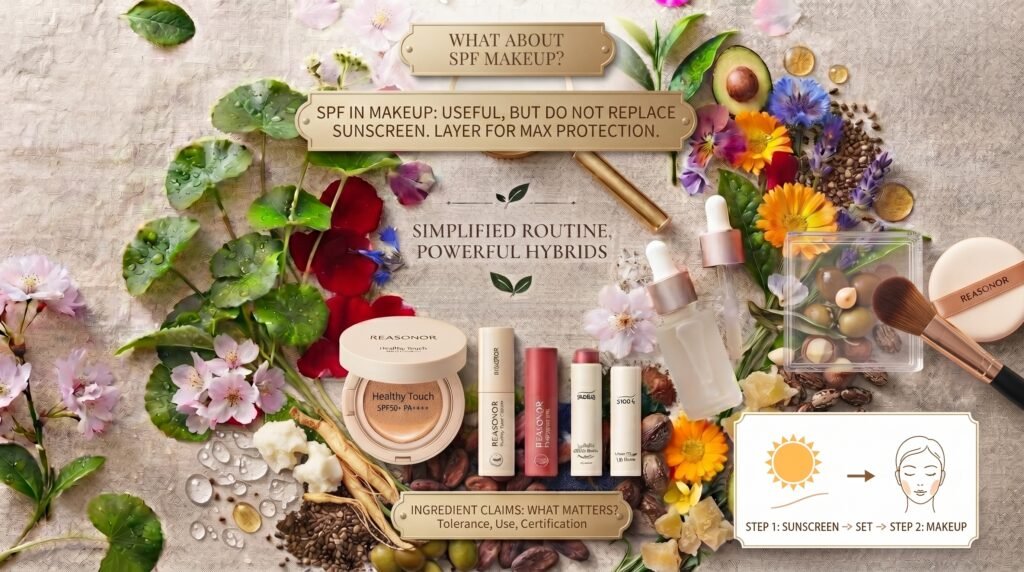
REASONOR currently lists its Healthy Touch Cushion with SPF50+ PA++++.
That can be useful, but makeup with an SPF claim should not automatically replace your dedicated sunscreen routine. Most people apply much less foundation or cushion product than the amount used to establish the labeled SPF protection.
For strong sun exposure, a better approach is:
Dedicated sunscreen → allow it to set → makeup
This is especially relevant in regions with intense sunlight and very high summer temperatures.
Can Organic K-Beauty Work in Hot, Humid Weather?
Yes, but climate matters.
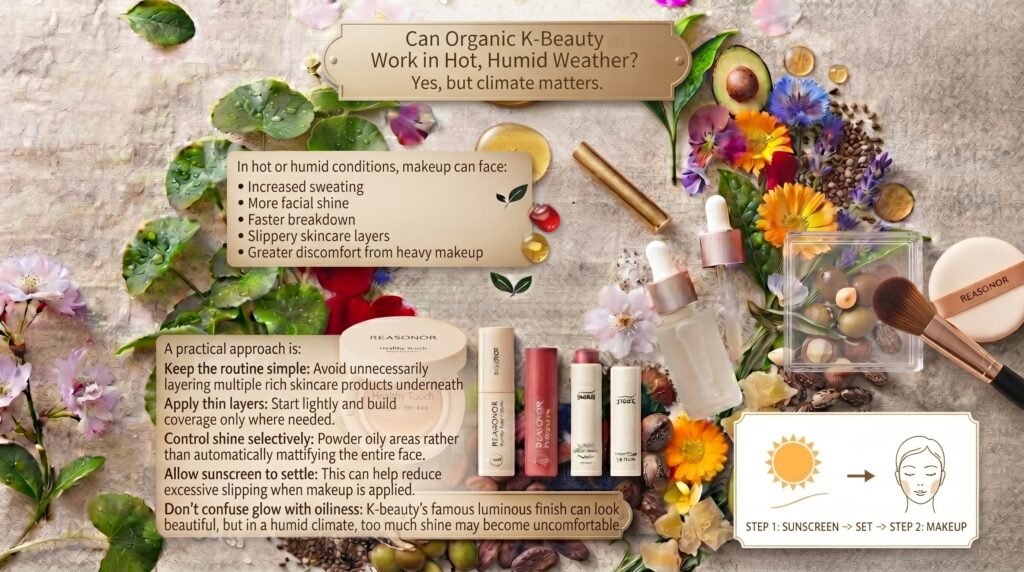
In hot or humid conditions, makeup can face:
- Increased sweating
- More facial shine
- Faster breakdown
- Slippery skincare layers
- Greater discomfort from heavy makeup
A practical approach is:
Keep the routine simple: Avoid unnecessarily layering multiple rich skincare products underneath makeup.
Apply thin layers: Start lightly and build coverage only where needed.
Control shine selectively: Powder oily areas rather than automatically mattifying the entire face.
Allow sunscreen to settle: This can help reduce excessive slipping when makeup is applied.
Don’t confuse glow with oiliness: K-beauty’s famous luminous finish can look beautiful, but in a humid climate, too much shine may become uncomfortable.
Is Organic Makeup More Sustainable?
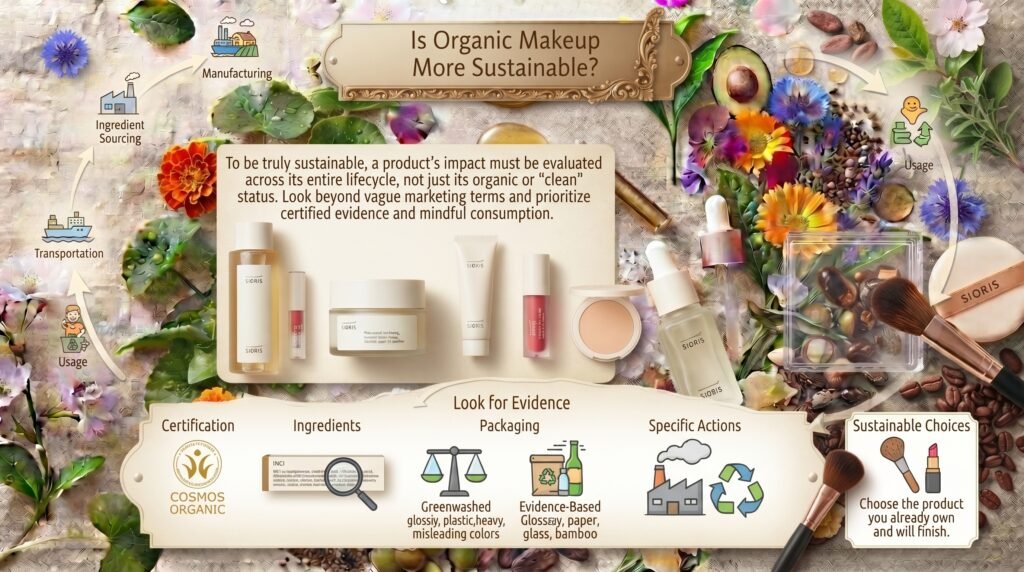
Not automatically. Organic certification and environmental sustainability overlap in some areas, but they are not the same thing. A product’s overall environmental impact can involve:
- Ingredient sourcing
- Agriculture
- Manufacturing
- Packaging
- Transportation
- Water use
- Product waste
- How long the product lasts
- Whether consumers actually finish it
SIORIS, for example, describes broader sustainability initiatives involving packaging, responsible sourcing, and environmental programs in addition to its COSMOS certification. That broader information is useful—but it should not be confused with the organic certification itself.
How to Avoid Greenwashing
Be cautious when you see claims such as:
- “100% clean”
- “Chemical-free”
- “Toxin-free”
- “Earth-friendly”
- “Natural beauty”
- “Organic-inspired”
unless the claim is clearly defined and supported.
Look for evidence instead:
Certification: Who certified it?
Ingredients: Is the full INCI list available?
Packaging: What material is actually used?
Sustainability: Are there specific actions or only vague promises?
Product level: Is the exact product certified, or only the brand?
This is particularly important because attractive green packaging is not proof of environmental performance.
How to Build a More Sustainable K-Beauty Routine
You do not need ten or twelve products to create a good K-beauty routine.
A practical minimalist routine can be:
Morning
- Cleanser, if needed
- Moisturizer appropriate to your skin
- Dedicated sunscreen
- One complexion product
- One lip product
Evening
- Makeup removal
- Cleanser
- Treatment, if genuinely needed
- Moisturizer
The sustainability advantage comes from using products purposefully, not simply buying products labeled sustainable.
Five simple rules
- Finish products before replacing them.
- Avoid buying duplicate shades.
- Choose multifunctional products when they genuinely replace another product.
- Check packaging before assuming a product is environmentally friendly.
- Do not buy a product simply because it is trending.
The most sustainable cosmetic is often the one you already own and will actually finish.
Certified Organic vs. Clean vs. Conventional: Which Should You Choose?
Choose certified organic if:
- Independent certification is important to you.
- You specifically want organic ingredients under a recognized standard.
- You want to verify the claim through a certification database.
Choose clean K-beauty if:
- You have your own ingredient preferences.
- You want to avoid particular ingredients.
- Organic certification is not essential.
Choose conventional K-beauty if:
- Shade range is your priority.
- You need a particular finish or coverage.
- You have already found a formula that works extremely well for you.
There is no reason to sacrifice an appropriate shade, comfortable wear, or skin compatibility simply because a product carries an attractive sustainability label.
Final Verdict: The Best Verified Options
If your priority is certified-organic Korean complexion makeup, the REASONOR Healthy Touch Cushion is the strongest match identified in this research. Its three listed shades are currently shown in the COSMOS directory as ORGANIC.
If you want certified-organic Korean lip color, the REASONOR Healthy Touch Tint is a strong option, with four verified shades currently listed as ORGANIC.
If you want a genuine color-plus-care hybrid, SIORIS LipSafer Color Balm Reddish is one of the clearest examples because its format sits between lip makeup and lip care. If your priority is organic minimalist lip care, SIORIS More Than Lip Balm is the more appropriate choice.
The Bottom Line
The biggest mistake in clean-beauty shopping is assuming that every product with botanical ingredients, Korean branding, attractive green packaging, or “clean” language is organic.
It isn’t. Certified organic, natural, clean, vegan, cruelty-free, and skincare-infused are different claims. The current certified-organic Korean makeup market is relatively small, but that makes careful verification even more important.
The smartest approach is simple: Verify the certification. Read the ingredients. Check the shade and performance. Consider your climate. Examine the packaging. Then ask whether you actually need the product.
A sustainable beauty routine does not have to mean giving up the innovation that made K-beauty popular. It can mean taking the best part of that philosophy thoughtful, multifunctional beauty and combining it with better ingredient transparency, credible certification and less unnecessary consumption.
In the end, the goal is not to own more “clean” products. It is to build a beauty routine that works for your skin, your values, and the planet while buying only what you will genuinely use.
Related Guides
Organic Concealer Guide: Can One Fix Both Under-Eyes and Blemishes?
Organic Serums Decoded: Which Natural Actives Are Actually Stable?
Organic Foundation Guide 2026: Find Your Perfect Match
How to Choose Organic Lipstick: A Shade-by-Shade, Ingredient-by-Ingredient Guide
10 Proven Ways to Reduce Your AC Energy Bills in the GCC

10 Best Passive Cooling Techniques for GCC Homes