Buying an organic concealer sounds simple until you use it on different parts of your face. A formula that looks smooth, fresh, and almost invisible under the eyes can suddenly look shiny or slide away when placed over a blemish. Conversely, a highly pigmented, long-wearing concealer that covers a red spot beautifully may settle into fine lines and make dry under-eyes look more textured. That does not necessarily mean either product is poorly made. It often means the formulation is solving a different cosmetic problem.
The under-eye area has fine lines, movement and visible changes in moisture and texture. Blemishes, meanwhile, usually require localized coverage, adhesion, pigment concentration and controlled shine. The visual objective is also different: under-eye makeup often benefits from controlled light diffusion, while blemish makeup generally needs to make the spot less noticeable rather than brighter. The best under-eye concealer is designed to move with the skin and visually soften the area. The best blemish concealer is designed to stay put and visually neutralize the spot.

Under-Eyes vs. Blemishes: The Formulation Battle
| Feature | Under-Eye Area | Blemish Area |
| Main concern | Darkness, dryness, fine lines | Redness, discoloration, uneven texture |
| Ideal texture | Thin, flexible, creamy | Concentrated and adherent |
| Coverage | Medium/buildable | Medium-high/targeted |
| Finish | Natural, satin or softly luminous | Natural, satin or soft matte |
| Hydration | Important | Moderate |
| Light reflection | Often helpful | Usually minimized |
| Creasing risk | High | Lower |
| Oil control | Less important | More important |
| Flexibility | Very important | Important |
| Precision | Moderate | Very important |
This explains why the idea of one universal concealer has limitations. A very moisturizing and reflective formula may look beautiful under the eyes but emphasize the shine or raised texture of a blemish. A highly matte, pigment-rich formula can effectively disguise redness but can make dry under-eye texture more visible.
Formulation tendencies are not absolute rules. Modern concealers can be engineered to balance several properties, but every formulation involves trade-offs.
Why Under-Eye Skin Needs a Different Concealer
The periorbital region has distinctive anatomical characteristics and is particularly susceptible to visible wrinkling and pigmentation. For makeup purposes, that means the formula should generally be comfortable and flexible rather than simply as opaque and matte as possible.

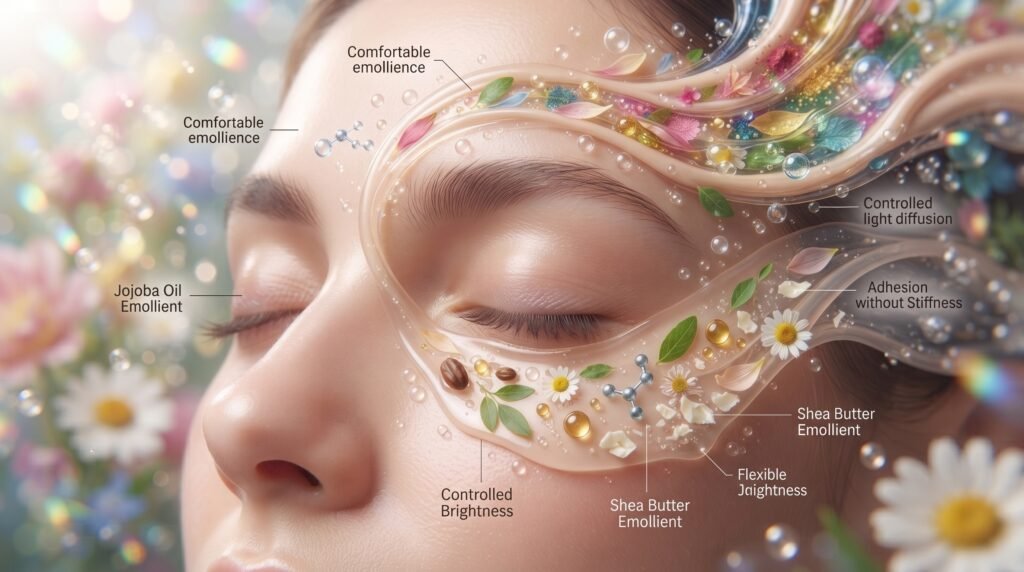
A good under-eye concealer should ideally offer:
- Comfortable emollience
- A thin, flexible texture
- Easy blending
- Medium or buildable coverage
- Controlled light diffusion
- Minimal drag during application
- Limited powderiness
- Good adhesion without becoming stiff
- A finish that does not exaggerate fine lines
| Under-Eye Need | Helpful Formulation Characteristic | Why It Matters |
| Dry-looking skin | Emollients + humectants | Improves surface feel and appearance |
| Fine lines | Flexible texture/film system | Helps avoid a stiff, heavy appearance |
| Darkness | Appropriate pigment blend | Visually neutralizes discoloration |
| Dullness | Controlled optical effect | Can create a fresher appearance |
| Creasing | Balanced texture | Reduces excessive product accumulation |
| Sensitive area | Well-tolerated formula | Improves cosmetic comfort |
The goal is not to make the under-eye area look wet. It is to create a smooth, flexible surface with controlled brightness.
Organic Ingredients That Make Sense Under the Eyes
Jojoba Oil
Jojoba oil is primarily useful here as an emollient, helping improve slip and surface suppleness. Research on jojoba derivatives supports their use in cosmetic formulations where lubricity and emollience are desirable. It should not, however, be described as a treatment for dark circles.
Squalane
Squalane is another lightweight emollient that can contribute to a smooth skin feel. Cosmetic safety reviews have found squalane and squalene safe under their assessed cosmetic conditions of use, although they are chemically different substances.
Squalane is the hydrogenated, more oxidation-stable derivative; squalene is a naturally occurring unsaturated lipid. Do not use the names interchangeably.
Shea Butter
Shea butter can provide richer emollience and is useful in creamier formulations. The trade-off is texture: too much richness can make a concealer feel heavy or increase movement and creasing for some users.
Other useful formulation components
- Glycerin: a humectant that can support water retention within a properly balanced formula.
- Plant-derived esters: can improve slip and spreadability.
- Lightweight botanical oils: may provide emollience without necessarily creating a heavy finish.
- Ceramide-containing systems: may support a skin-comfort positioning when properly formulated.
- Botanical extracts: can have specific cosmetic roles, but “botanical” alone is not evidence of superior performance.
| Ingredient | Potential Cosmetic Role | Under-Eye Suitability | Important Consideration |
| Jojoba oil | Emollient | High | Overall formula balance matters |
| Squalane | Lightweight emollient | High | Does not treat dark circles |
| Shea butter | Rich emollient | Moderate-high | May feel heavy for some users |
| Glycerin | Humectant | High | Needs a balanced formula |
| Plant esters | Slip/emollience | High | Depends on the specific ester |
| Botanical extracts | Supporting cosmetic role | Formula-dependent | Natural origin does not guarantee benefit |
Why Light Reflection Matters Under the Eyes
Under-eye brightening is partly an optical exercise. Fine particles and carefully engineered textures can scatter or diffuse incoming light, producing a softer visual effect. This is different from adding obvious shimmer.

| Finish | Typical Under-Eye Effect |
| Matte | Can emphasize dryness or texture |
| Satin | Versatile and natural-looking |
| Soft luminous | Can create a fresher appearance |
| Glittery | Usually inappropriate for everyday coverage |
| Very dewy | May increase movement or creasing for some users |
The important distinction is light diffusion versus visible sparkle. Optical ingredients can change how darkness and texture appear, but they do not remove the underlying cause of dark circles.
Why Blemishes Need a Different Formula
Blemish concealing is primarily about coverage, pigment concentration, adhesion, precision, and finish. The objective is usually to make a localized area blend into the surrounding complexion. That is why a highly reflective formula can sometimes work against the desired result.
| Blemish Requirement | Useful Formulation Characteristic |
| Redness coverage | Appropriate pigment concentration |
| Spot correction | High-pigment targeted formula |
| Longevity | Good adhesion/film-forming properties |
| Shine control | Satin or soft-matte finish |
| Precision | Small applicator or brush-friendly texture |
| Texture camouflage | Thin, buildable layers |
A good blemish formula does not necessarily need to be extremely dry or completely matte. Satin can be more forgiving than flat matte, particularly when the surrounding skin is dry.
Organic Ingredients for Blemish Concealing

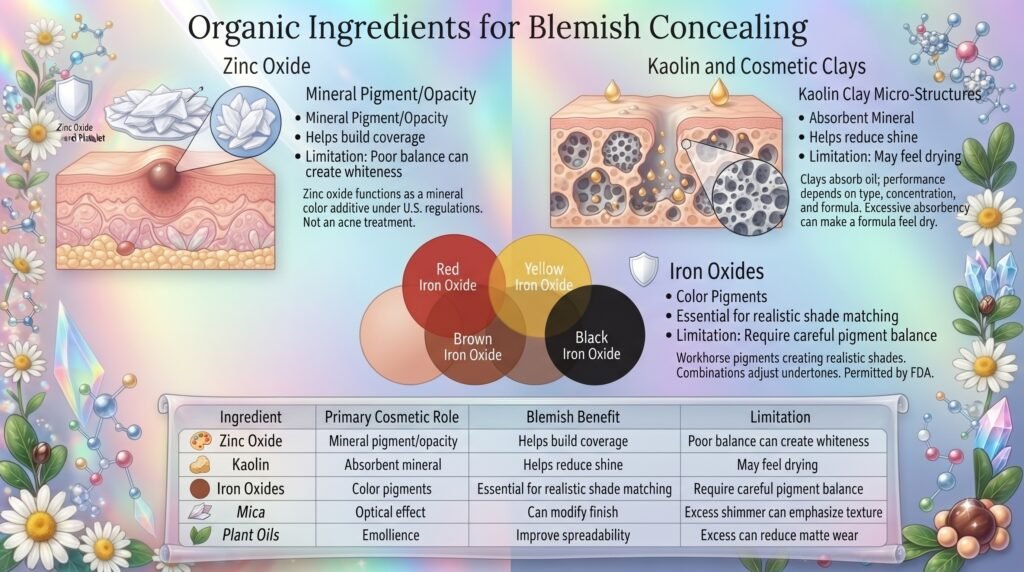
Zinc Oxide
Zinc oxide can function as a mineral color additive in cosmetics, including products used around the eye area under U.S. regulations. Its presence should be understood in the context of the complete pigment system. Zinc oxide in a concealer is not automatically an acne treatment.
Kaolin and Other Cosmetic Clays
Clays such as kaolin can absorb oil and are used in cosmetic formulations for their adsorbent and rheological properties. Research on clay-based formulations supports their ability to reduce surface oiliness, although performance depends on clay type, concentration, and the complete formula. The downside is equally important: excessive absorbency can make a formula feel dry.
Iron Oxides
Iron oxides are among the workhorse pigments used to create realistic shades of complexion. Different combinations of red, yellow, brown, and black tones allow formulators to create shades for different skin tones and adjust undertones. FDA sources list iron oxides as permitted cosmetic color additives, including for use in the eye area in the United States.
| Ingredient | Primary Cosmetic Role | Blemish Benefit | Limitation |
| Zinc oxide | Mineral pigment/opacity | Helps build coverage | Poor balance can create whiteness |
| Kaolin | Absorbent mineral | Helps reduce shine | May feel drying |
| Iron oxides | Color pigments | Essential for realistic shade matching | Require careful pigment balance |
| Mica | Optical effect | Can modify finish | Excess shimmer can emphasize texture |
| Plant oils | Emollience | Improve spreadability | Excess can reduce matte wear |
Zinc Oxide Does Not Automatically Mean “Acne-Treating”. This is one of the most important distinctions in natural and mineral makeup.
| Myth | Fact |
| “Zinc oxide concealer treats acne.” | Zinc oxide can function as a cosmetic pigment; treatment claims require appropriate evidence and regulatory status. |
| “Clay automatically heals pimples.” | Clay can absorb oil but is not automatically an acne treatment. |
| “Natural pigments are always safer.” | Safety depends on the substance, purity, exposure and formulation. |
| “Organic concealer cannot clog pores.” | Organic certification does not guarantee non-comedogenic performance. |
Cosmetic products must be evaluated according to their actual ingredients, intended use and regulatory claims rather than the marketing story surrounding them.
Under-Eye vs. Blemish Ingredients: Side-by-Side
| Ingredient/Feature | Under-Eye Concealer | Blemish Concealer |
| Jojoba | Excellent candidate | Moderate |
| Squalane | Excellent candidate | Moderate |
| Shea butter | Useful when balanced | Potentially too rich |
| Glycerin | Useful | Formula-dependent |
| Zinc oxide | Useful pigment | Very useful in mineral coverage |
| Kaolin | Usually limited | Useful for oil-control formulas |
| Iron oxides | Essential for shade | Essential for shade |
| Soft-focus pigments | Highly useful | Use cautiously |
| High pigment load | Moderate | High/targeted |
| Matte finish | Often less desirable | Often useful |
| Luminous finish | Often useful | Usually minimized |
Why One Organic Concealer Often Compromises Both Jobs
Consider what happens when one formula is pushed toward one extreme.

If it is extremely moisturizing:
- It may crease more easily.
- It may move over blemishes.
- It can look shiny.
- It may require strategic setting.
If it is extremely matte:
- It can emphasize under-eye dryness.
- It may settle into fine lines.
- It can appear heavier.
- It may become patchy.
If it is extremely high coverage:
- More product may be needed to blend it.
- Texture can become more noticeable.
- Under-eyes may look cakey.
If it is highly luminous:
- It can brighten the under-eye area.
- But it may visually emphasize raised blemishes.
| Formula Priority | Best Area |
| Hydration | Under-eyes |
| Soft luminosity | Under-eyes |
| Flexible coverage | Under-eyes |
| High pigment | Blemishes |
| Oil control | Blemishes |
| Soft matte finish | Blemishes |
| Precise application | Blemishes |
Powder, Liquid, Cream or Stick?
| Formula Type | Under-Eyes | Blemishes | Main Advantage | Main Limitation |
| Liquid | Excellent | Excellent | Flexible and buildable | Longevity varies |
| Cream | Excellent | Excellent | Rich, blendable texture | Can be too emollient |
| Stick | Moderate | Excellent | Precise and concentrated | Can drag or feel heavy |
| Powder | Usually limited | Moderate | Oil control | Can emphasize dryness |
Format alone does not determine performance. The full formulation, pigment dispersion, film-forming system, and emollient balance matter more.
How to Choose Your Under-Eye Concealer
| Skin Area / Situation | What to Look For | Ingredients / Formulation Features to Consider | Application Tips |
| Under-eyes – General | Creamy or flexible texture; medium/buildable coverage; controlled luminosity; minimal glitter; easy blending; suitable shade and undertone | Comfortable emollients; balanced formula; transparent ingredient labeling; appropriate packaging | Use a thin, even layer and blend gently |
| Dry-looking under-eyes | Hydrating, comfortable texture; satin or softly luminous finish | Squalane, jojoba, glycerin, balanced emollients | Avoid applying excessive product, which can emphasize texture |
| Under-eyes that crease easily | Lightweight, flexible formula; controlled emollience | Flexible texture; moderate coverage; avoid overly rich or heavy formulas | Apply thin layers and minimize excess product |
| Under-eyes – Sensitive skin | Simple, well-tolerated formula; fragrance considerations | Avoid ingredients you know your skin does not tolerate; check the complete ingredient list | Patch-test new products when appropriate |
| Blemishes – General | Higher pigment concentration; precise application; good adhesion; satin or soft-matte finish | Appropriate mineral pigments; iron oxides; balanced film-forming and emollient systems | Apply in thin, targeted layers rather than one thick layer |
| Oily skin + blemishes | Shine-controlled, lightweight formula; good staying power | Lightweight emollients; suitable absorbent powders; appropriate clay levels; shine-controlling ingredients | Build coverage gradually and avoid excessive product |
| Dry blemish areas | Flexible, comfortable coverage; natural or satin finish | Balanced emollients; flexible film-forming system; moderate rather than excessive powder | A flexible satin formula may look more natural than an aggressively matte formula |
| Raised or textured blemishes | Precise, thin coverage; controlled finish | High-pigment formula without excessive luminosity | Avoid heavy layers and highly reflective finishes that may emphasize texture |
| Shade matching | Correct undertone and depth | — | Under-eyes can sometimes use a slightly brightening shade; blemishes generally benefit from a closer skin match |
| General buying rule | Choose according to the area being concealed | Evaluate the complete formulation, not just individual “natural” ingredients | Remember: no concealer ingredient should be expected to eliminate wrinkles, dark circles or acne |
Shade Matching: Under-Eyes and Blemishes Need Different Strategies

| Application | General Shade Strategy |
| Under-eyes | Slightly brightening or appropriately matched undertone |
| Red blemishes | Skin-matching shade, with optional color correction |
| Dark spots | Skin-matching or targeted corrective approach |
| Raised acne texture | Thin layers; avoid excessive brightness |
For blemishes, the closer the shade matches the surrounding skin, the easier it is to make the spot visually disappear. For the under-eyes, a slightly brighter shade can create a fresher appearance, but excessive brightness can create an obvious contrast. Always consider undertone: warm, cool, neutral, and olive.
Organic Certification vs. “Natural” Concealer Claims
| Claim | What It Can Tell You | What It Does Not Guarantee |
| Organic | Compliance with a defined certification standard | Perfect performance |
| Natural | Natural-origin positioning under a stated definition | Non-comedogenic performance |
| Clean | Brand-specific ingredient philosophy | Scientific superiority |
| Vegan | No animal-derived ingredients under stated criteria | Better skin performance |
| Cruelty-free | Animal-testing policy | Better formulation |
| Mineral | Mineral ingredients/pigments are emphasized | Suitability for everyone |
| Non-comedogenic | A non-comedogenic positioning or test | Zero breakouts for every user |
For example, the COSMOS standard has defined certification and labeling requirements, including identification of certification bodies and rules governing use of organic claims.
“Organic” describes sourcing and certification criteria; it does not automatically tell you whether a concealer is right for your under-eyes or blemishes.
Packaging and Sustainability
Packaging is part of sustainable beauty, but the answer is more complicated than “glass is good, plastic is bad.”
| Packaging Choice | Performance Consideration | Sustainability Consideration |
| Heavy glass | Premium feel | Higher transport weight |
| Lightweight plastic | Convenient | Material/recycling considerations |
| Refillable compact | Reduces repeated packaging | Requires an effective refill system |
| Airless pump | Can help protect a formula | More complex packaging |
| Minimal packaging | Less material | Must still protect the product |
Life-cycle research shows that packaging sustainability depends on the entire system. Glass can carry a transportation burden due to its weight, while recycled polymers and reuse systems can alter the environmental balance. So, evaluate the following: Material quantity, recycled content, recyclability, manufacturing, transportation, refillability, and product waste.
The Same Principle Applies Across Beauty. The formulation lesson extends beyond concealer. Korean Beauty often demonstrates the value of thin, layered textures. An Organic Foundation must balance pigment, spreadability, wear, and skin feel. Organic Lipstick strikes a balance among pigment, slip, structure, and comfort. An organic serum solves a completely different formulation problem than makeup does.
That is why Organic Makeup, Natural Makeup, Clean Beauty, Organic Skincare, and Sustainable Beauty should not be judged by ingredient labels alone. The formulation must be evaluated for the job it performs.
Can One Concealer Really Do Both? Yes—sometimes. A well-balanced concealer can work reasonably well under the eyes and on occasional blemishes. But “good at everything” is not necessarily the same as “optimized for everything.”
| If You Want One Product For… | Look For |
| Under-eyes + occasional blemishes | Medium coverage, flexible satin finish |
| Mostly under-eyes | Lightweight, comfortable, softly luminous |
| Mostly blemishes | Higher pigment, precise, satin/soft matte |
| Dry skin + blemishes | Flexible coverage without excessive powder |
| Oily skin + under-eyes | Balanced rather than extremely matte |
If you regularly conceal both areas, owning two complementary textures may actually produce a more natural result while using less product.
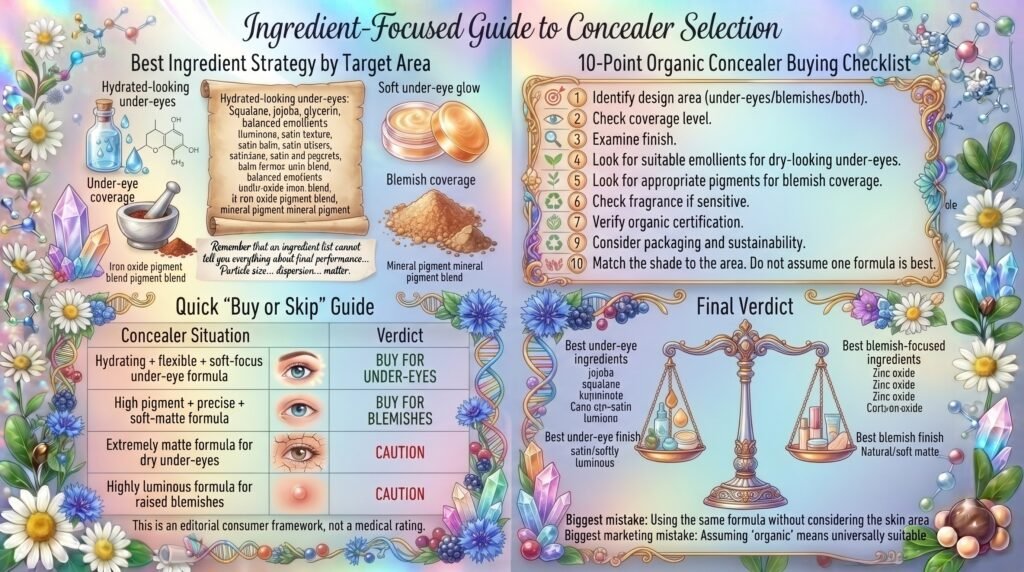
Best Ingredient Strategy by Target Area

| Goal | Ingredients/Formulation Features to Consider |
| Hydrated-looking under-eyes | Squalane, jojoba, glycerin, balanced emollients |
| Soft under-eye glow | Fine optical pigments, satin texture |
| Under-eye coverage | Appropriate iron oxide/pigment blend |
| Blemish coverage | Iron oxides + suitable mineral pigments |
| Shine control | Kaolin or other suitable absorbent powders |
| Long wear | Appropriate film-forming system |
| Flexible finish | Balanced emollient + film-former system |
| Mineral makeup approach | Zinc oxide + iron oxides + suitable mineral pigments |
Remember that an ingredient list cannot tell you everything about final performance. Concentration, particle size, pigment dispersion, emulsification, film formation, and ingredient interactions all matter.
Quick “Buy or Skip” Guide
| Concealer Situation | Verdict |
| Hydrating + flexible + soft-focus under-eye formula | BUY FOR UNDER-EYES |
| High pigment + precise + soft-matte formula | BUY FOR BLEMISHES |
| Extremely matte formula for dry under-eyes | CAUTION |
| Highly luminous formula for raised blemishes | CAUTION |
| “Organic” claim with no certification information | INVESTIGATE |
| Natural ingredients + transparent INCI + appropriate formulation | STRONG OPTION |
| Claims to treat acne without appropriate evidence | CAUTION |
| Excellent ingredient marketing but poor shade selection | SKIP |
Final Verdict
| Category | Best Strategy |
| Best under-eye ingredients | Jojoba, squalane, glycerin and balanced emollients |
| Best blemish-focused ingredients | Zinc oxide, iron oxides, suitable clays and high-pigment systems |
| Best under-eye finish | Satin/softly luminous |
| Best blemish finish | Natural/satin to soft matte |
| Best under-eye coverage | Medium/buildable |
| Best blemish coverage | Medium-high/targeted |
| Biggest mistake | Using the same formula without considering the skin area |
| Biggest marketing mistake | Assuming “organic” means universally suitable |
Conclusion: Your Under-Eyes and Blemishes Are Not the Same Formulation Problem
The most useful way to shop for organic concealer is to stop asking, “Which product has the best ingredients?” and start asking, “Which formulation solves my specific cosmetic problem?”
Under-eyes generally benefit from comfort, flexibility, hydration and controlled light reflection. Blemishes generally benefit from precision, pigment, adhesion and controlled shine.
That does not mean you need two concealers. A versatile formula can absolutely work for both. But if you have very dry under-eyes and oily, highly visible blemishes, expecting a single texture to perform perfectly in both areas may be unrealistic.
Evaluate the complete picture: skin area + formulation + ingredients + pigments + texture + coverage + finish + packaging + certification + Sustainability.
The best organic makeup is not necessarily the product with the longest list of natural ingredients. It is the product whose formulation is intelligently designed for the job you need it to do.