A serum can contain organic oils, botanical extracts, beautiful packaging, and an impressive ingredient list and still have a poorly protected active ingredient.
That is especially important with ingredients such as vitamin C and retinoids. Oxygen, light, heat, water, pH, and repeated exposure to air can gradually change sensitive molecules. Vitamin C is particularly challenging: L-ascorbic acid is chemically unstable, and its performance depends heavily on formulation conditions.
This does not mean organic or natural skincare is ineffective. It means the ingredient on the front label is only part of the story. A genuinely good serum needs the right active form, formulation environment, preservation system, packaging, and storage conditions.
That raises the question consumers should really be asking: Is the active ingredient still in a usable form by the time the serum reaches my skin?
What Does “Stable” Actually Mean in a Serum?
“Stable” does not simply mean that a bottle looks good six months later. A cosmetic chemist considers several kinds of stability:
| Stability type | What it means | Why consumers should care |
| Chemical | The active remains chemically intact | Determines whether the ingredient can perform as intended |
| Physical | Texture, color, viscosity and appearance remain acceptable | Helps indicate formula integrity |
| Microbiological | Product remains protected against harmful microbial growth | Important for safety |
| Packaging | Container protects the formula from light, oxygen and contamination | Particularly important for sensitive actives |
| After-opening | Product remains suitable during normal use | Determines how much usable life remains once opened |
A change in color or smell can be a warning sign, but appearance alone cannot tell you exactly how much active remains. Laboratory testing is needed to measure chemical degradation. That distinction matters because a serum can look perfectly normal while losing some of its original active concentration.
Why “Natural” Does Not Automatically Mean Stable
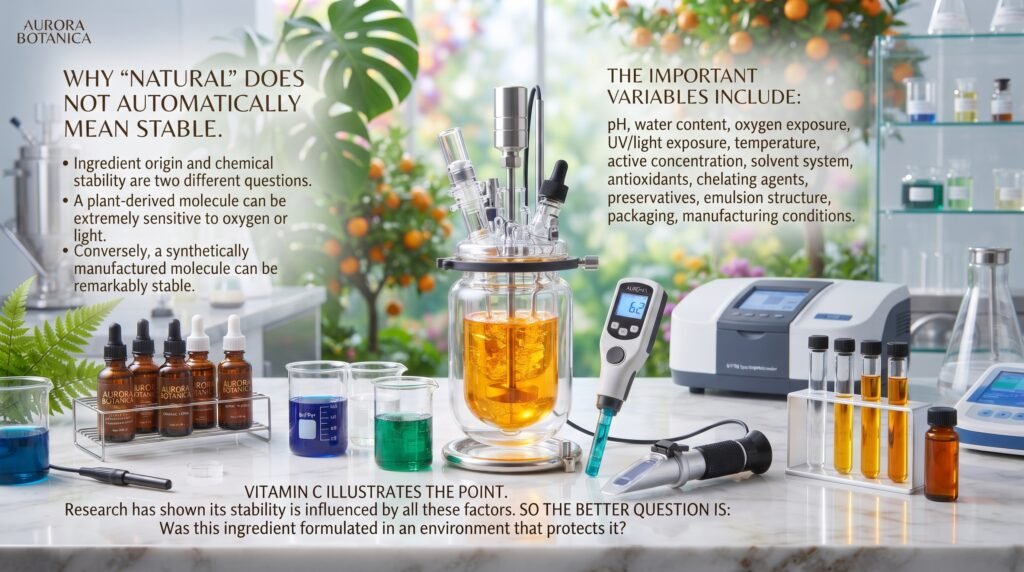
Ingredient origin and chemical stability are two different questions. A plant-derived molecule can be extremely sensitive to oxygen or light. Conversely, a synthetically manufactured molecule can be remarkably stable.
The important variables include:
- pH
- water content
- oxygen exposure
- UV/light exposure
- temperature
- active concentration
- solvent system
- antioxidants
- chelating agents
- preservatives
- emulsion structure
- packaging
- manufacturing conditions
Vitamin C illustrates the point particularly well. Research has shown that its stability can be influenced by oxygen, pH, temperature, formulation composition, and light exposure.
So, the better question is not: “Is this ingredient natural?” It is: “Was this ingredient formulated in an environment that protects it?”
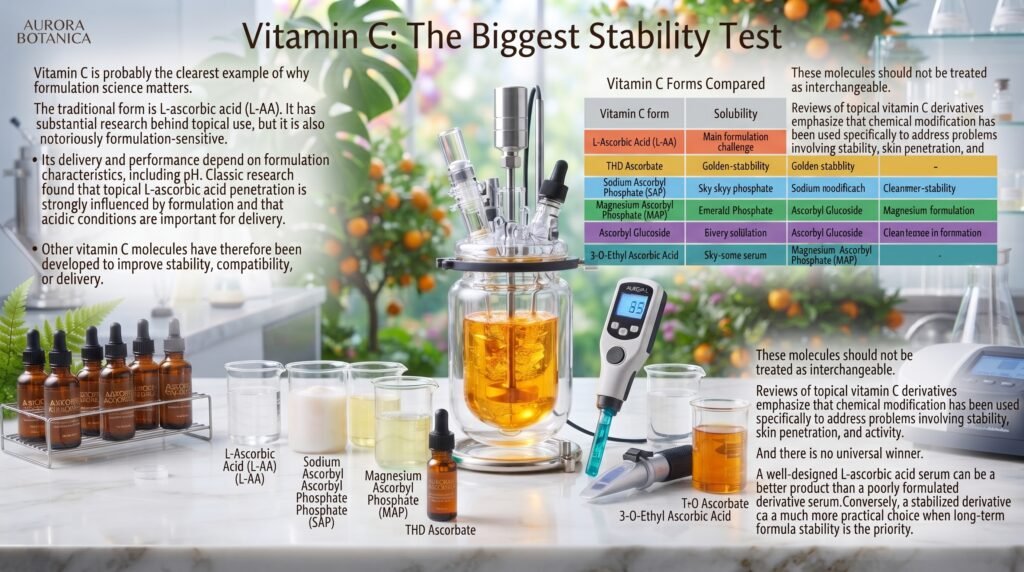
Vitamin C: The Biggest Stability Test
Vitamin C is probably the clearest example of why formulation science matters. The traditional form is L-ascorbic acid (L-AA). It has substantial research behind topical use, but it is also notoriously formulation-sensitive.
Its delivery and performance depend on formulation characteristics, including pH. Classic research found that topical L-ascorbic acid penetration is strongly influenced by formulation and that acidic conditions are important for delivery. Other vitamin C molecules have therefore been developed to improve stability, compatibility, or delivery.
Vitamin C Forms Compared
| Vitamin C form | Relative stability | Solubility | Main formulation challenge | Consumer takeaway |
| L-Ascorbic Acid | Lower | Water-soluble | Oxidation, pH and light sensitivity | Excellent research history, but formulation is critical |
| THD Ascorbate | Generally higher | Oil-soluble | Requires appropriate oil-phase formulation | Attractive option for oil-based formulas |
| Sodium Ascorbyl Phosphate (SAP) | Higher than L-AA | Water-soluble | Formula compatibility and pH | Useful stabilized derivative |
| Magnesium Ascorbyl Phosphate (MAP) | Relatively stable | Water-soluble | pH/formulation compatibility | Often used when gentler formulation is desired |
| Ascorbyl Glucoside | More stable than L-AA | Water-compatible | Conversion and formula design | Common stabilized derivative |
| 3-O-Ethyl Ascorbic Acid | Generally, more stable than L-AA | Water-compatible | Stability remains formula-dependent | Useful derivative, but not automatically superior |
These molecules should not be treated as interchangeable. Reviews of topical vitamin C derivatives emphasize that chemical modification has been used specifically to address problems involving stability, skin penetration, and activity. And there is no universal winner.
A well-designed L-ascorbic acid serum can be a better product than a poorly formulated derivative serum. Conversely, a stabilized derivative can be a much more practical choice when long-term formula stability is the priority.
What Makes L-Ascorbic Acid Difficult?
The formulation must control:
- oxygen exposure
- pH
- light
- temperature
- water activity
- oxidation-promoting impurities
- packaging
Ferulic acid is one example of a supporting antioxidant that has been investigated in vitamin C/E systems. Research found that ferulic acid improved the chemical stability of a vitamin C and vitamin E solution and enhanced photoprotection in experimental models. That does not mean every serum containing ferulic acid is automatically stable. The entire formula still matters.
Which Vitamin C Form Makes Sense for an Organic Serum?
Use this as a practical framework:
| Your priority | What to look for |
| Traditional vitamin C research profile | L-Ascorbic Acid |
| Greater formulation stability | A validated vitamin C derivative |
| Oil-based serum | Oil-soluble derivative such as THD ascorbate |
| Water-based stabilized approach | SAP, MAP or another appropriate derivative |
| Reduced exposure during use | Opaque or airless packaging |
| Better oxidation control | Well-designed formula + antioxidant/chelating strategy + protective packaging |
One important warning: “Organic vitamin C” can be misleading. “Organic” in cosmetic marketing can refer to the certification status of the product or agricultural ingredients. It does not mean that a vitamin C molecule is magically protected from oxidation.
For example, COSMOS certification establishes requirements for organic and natural cosmetics, including rules governing ingredient origin and processing. It does not mean that every sensitive active in a certified product is chemically stable throughout its entire life.
Retinol and Retinoids: Can They Really Be “Organic”?
Retinoids are another major stability challenge.
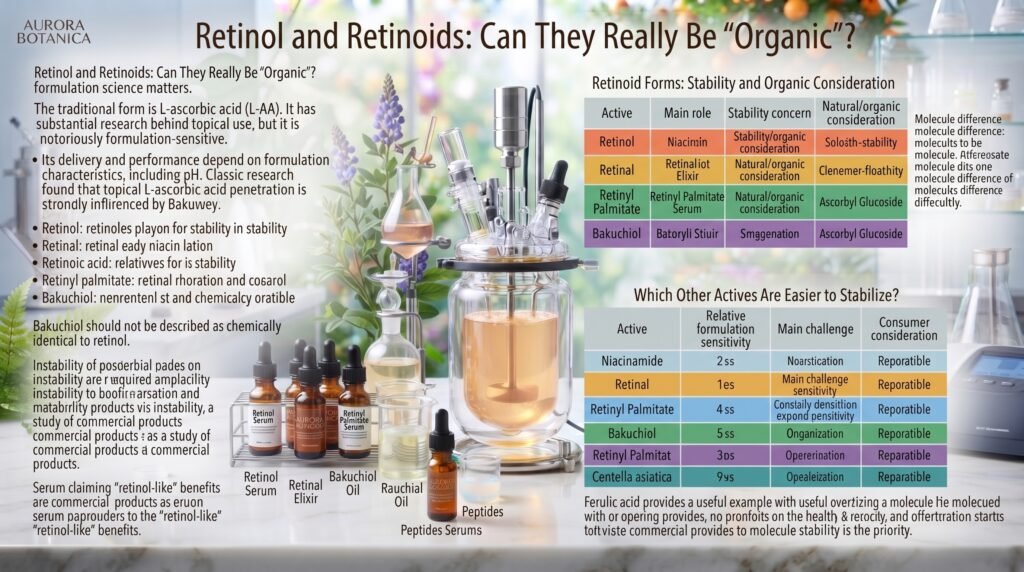
The terminology is important:
- Retinol — vitamin A alcohol
- Retinal — retinaldehyde
- Retinoic acid — active prescription retinoid
- Retinyl palmitate — esterified vitamin A derivative
- Bakuchiol — plant-derived compound often marketed as a retinol alternative
Bakuchiol should not be described as chemically identical to retinol. Retinoids are particularly sensitive to light, oxygen, and temperature. Recent reviews identify chemical instability as a major limitation in topical retinoid formulations.
| Active | Main role | Stability concern | Natural/organic consideration |
| Retinol | Retinoid skincare active | Light and oxygen sensitivity | Usually not what consumers mean by certified organic |
| Retinal | Retinoid active | Formulation-sensitive | Source and formulation vary |
| Retinyl Palmitate | Vitamin A ester | Generally, more stable than some retinoids | Source varies |
| Bakuchiol | Plant-derived cosmetic active | Formula stability still matters | Natural-origin retinol alternative, not retinol itself |
The importance of formulation is not theoretical. A study of commercial retinoid products found substantial degradation under both long-term and accelerated conditions, with light degradation particularly important.
A serum claiming “retinol-like” benefits should make it clear whether it contains: actual retinol, another retinoid, or a botanical alternative such as bakuchiol. Those are different ingredients with different evidence bases.
Which Other Actives Are Easier to Stabilize?
Not every active is a formulation nightmare.
| Active | Relative formulation sensitivity | Main challenge | Consumer consideration |
| Niacinamide | Generally easier | Formula compatibility and processing | Usually straightforward to formulate |
| Hyaluronic acid | Moderate | Molecular-weight, pH and processing effects | Formula quality matters more than “natural” label |
| Peptides | Moderate to high | Hydrolysis and formula compatibility can vary | Stability is peptide-specific |
| Ceramides | Moderate | Solubility and dispersion | Delivery system matters |
| AHAs | Moderate | pH and concentration | Formula pH strongly affects performance |
| BHAs | Moderate | Solubility and pH | Proper formulation is essential |
| Azelaic acid | Moderate | Solubility and texture | Delivery system affects usability |
| CoQ10 | Moderate | Poor water solubility and oxidation/light concerns | Often works better in suitable oil systems |
| Ferulic acid | Moderate | pH and temperature | Formula environment matters |
| Green tea polyphenols | Higher | Oxidation | Antioxidant protection and packaging matter |
| Resveratrol | Higher | Solubility and light/formulation stability | Requires thoughtful formulation |
| Licorice extract | Formula-dependent | Extract composition and processing | “Botanical” does not equal standardized |
| Centella asiatica | Formula-dependent | Extract composition and preservation | Quality depends heavily on extract and formula |
Ferulic acid provides a useful example: research has found its stability to be related to both pH and temperature, demonstrating why an ingredient cannot be judged independently of its formulation.
Organic vs Natural vs Clean: Don’t Confuse Them
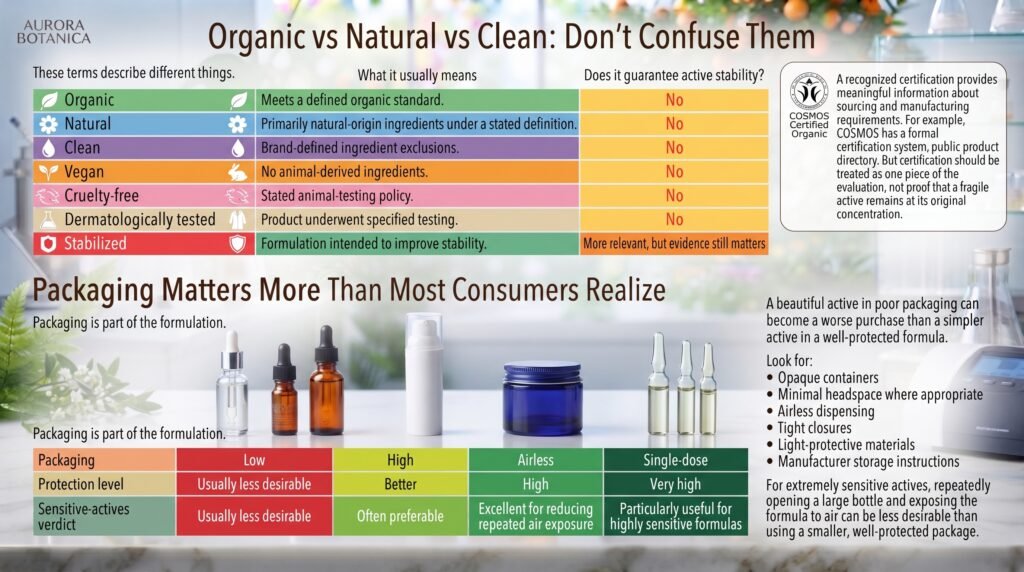
| Claim | What it usually means | Does it guarantee active stability? |
| Organic | Meets a defined organic standard | No |
| Natural | Primarily natural-origin ingredients under a stated definition | No |
| Clean | Brand-defined ingredient exclusions | No |
| Vegan | No animal-derived ingredients | No |
| Cruelty-free | Stated animal-testing policy | No |
| Dermatologically tested | Product underwent specified testing | No |
| Stabilized | Formulation intended to improve stability | More relevant, but evidence still matters |
A recognized certification can provide meaningful information about sourcing and manufacturing requirements. For example, COSMOS has a formal certification system and public product directory. But certification should be treated as one piece of the evaluation, not proof that a fragile active remains at its original concentration.
Packaging Matters More Than Most Consumers Realize
| Packaging | Protection level | Sensitive-actives verdict |
| Clear dropper bottle | Low | Usually less desirable |
| Amber glass | Moderate–high | Better |
| Opaque bottle | High | Often preferable |
| Airless pump | High | Excellent for reducing repeated air exposure |
| Single-dose packaging | Very high | Particularly useful for highly sensitive formulas |
A beautiful active in poor packaging can become a worse purchase than a simpler active in a well-protected formula.
Look for:
- Opaque containers
- Minimal headspace where appropriate
- Airless dispensing
- Tight closures
- Light-protective materials
- Manufacturer storage instructions
For extremely sensitive actives, repeatedly opening a large bottle and exposing the formula to air can be less desirable than using a smaller, well-protected package.
How to Tell If Your Vitamin C Serum Has Oxidized
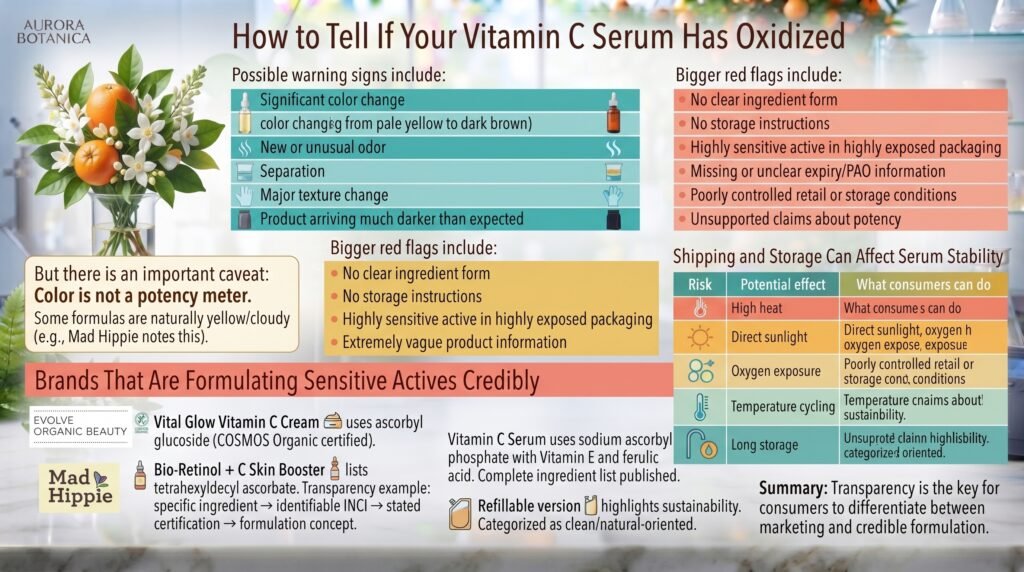
Possible warning signs include:
- Significant color change
- New or unusual odor
- Separation
- Major texture change
- Product arriving much darker than expected
But there is an important caveat:
Color is not a potency meter.
Some vitamin C formulas naturally have a yellow, amber, or cloudy appearance because of the ingredients used. Mad Hippie’s current vitamin C serum, for example, notes that its pale yellow/cloudy appearance may be normal due to botanical ingredients. So don’t automatically throw away every yellow vitamin C serum.
Bigger red flags include:
- No clear ingredient form
- No storage instructions
- Highly sensitive active in highly exposed packaging
- Extremely vague product information
- Missing or unclear expiry/PAO information
- Poorly controlled retail or storage conditions
- Unsupported claims about potency
Shipping and Storage Can Affect Serum Stability
| Risk | Potential effect | What consumers can do |
| High heat | Can accelerate degradation | Buy from reputable sellers |
| Direct sunlight | Can accelerate photodegradation | Store away from light |
| Oxygen exposure | Can promote oxidation | Close immediately after use |
| Temperature cycling | Can stress some formulas | Don’t leave products in hot cars |
| Long storage | Reduces remaining shelf life | Check dates and batch information |
This is particularly relevant in hot climates. If a serum arrives after sitting in extreme heat for days, don’t assume that the formula has been unaffected simply because the bottle looks normal.
Brands That Are Formulating Sensitive Actives Credibly
The safest approach is to distinguish between verified formulation information and marketing interpretation. One strong example is Evolve Organic Beauty. Its Vital Glow Vitamin C Cream uses ascorbyl glucoside, which is listed in its INCI, and states that the product is COSMOS Organic certified.
Its Bio-Retinol + C Skin Booster lists tetrahexyldecyl ascorbate alongside Bidens pilosa extract and organic botanical oils. The brand describes the product as a natural alternative to retinol rather than claiming it contains retinol itself. That is exactly the kind of transparency consumers should look for: specific ingredient → identifiable INCI → stated certification → identifiable formulation concept.
Another interesting example is Mad Hippie. Its Vitamin C Serum uses sodium ascorbyl phosphate, plus vitamin E and ferulic acid. The company describes SAP as a more stable form of vitamin C and publishes the complete ingredient list. It also offers a refillable version in the United States, making the product particularly interesting from a sustainability perspective.
However, Mad Hippie should be categorized as a clean/natural-oriented brand rather than automatically labeled a certified-organic serum brand unless the specific product carries an applicable certification.
What about other brands?
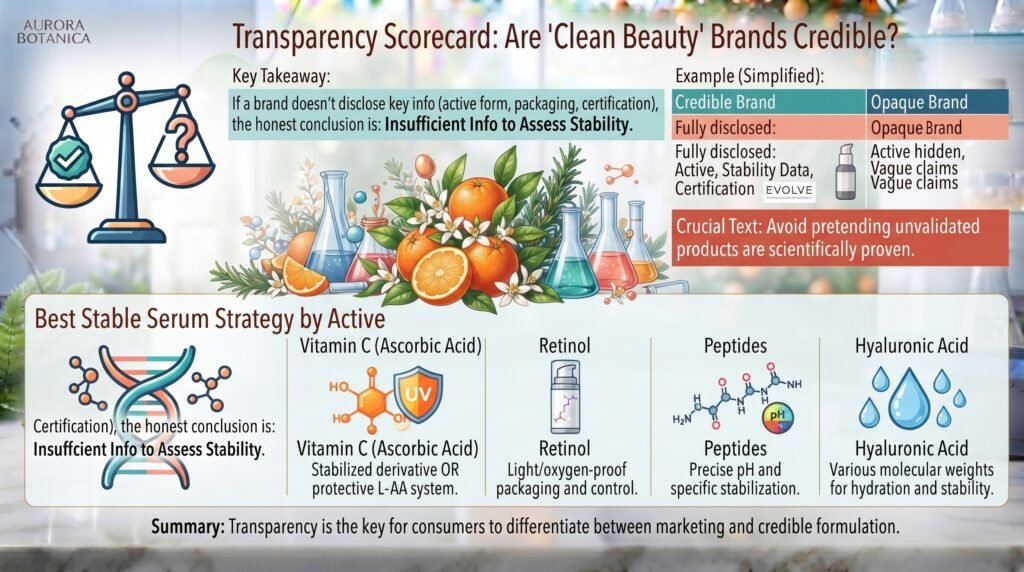
There are many natural, clean, and organic-looking serum brands on the market. But if a company does not disclose enough information to determine the exact active form, packaging, or certification status, the scientifically honest conclusion is: Insufficient publicly available formulation information to independently assess stability. That is much more useful than pretending that every “clean beauty” product has been scientifically validated.
Master Serum Comparison
| Brand/product | Key active | Active form | Formulation/stability evidence | Certification claim | Sustainability angle |
| Evolve Vital Glow Vitamin C Cream | Vitamin C | Ascorbyl glucoside | Stabilized derivative; full INCI disclosed | COSMOS Organic | Organic-certified formulation |
| Evolve Bio-Retinol + C Skin Booster | Vitamin C + botanical retinol alternative | THD ascorbate + Bidens pilosa | Oil-based formula with fat-soluble vitamin C | Brand provides independently verified certification/sustainability claims | Natural/oil-based approach |
| Mad Hippie Vitamin C Serum | Vitamin C | Sodium ascorbyl phosphate | SAP + vitamin E + ferulic acid; full INCI disclosed | Clean/natural positioning; do not classify as certified organic without product-specific evidence | Refillable option available in U.S. |
| Unverified “Organic Vitamin C” product | Vitamin C | Not disclosed | Impossible to independently assess | Unclear | Cannot assess |
Best Stable Serum Strategy by Active
| Active | Best formulation strategy | What to look for |
| Vitamin C | Stabilized derivative or carefully designed L-AA system | Correct active form, protective packaging |
| Retinol | Light/oxygen protection and controlled formulation | Opaque or airless packaging |
| Peptides | Peptide-specific stabilization | Appropriate pH and preservation |
| CoQ10 | Suitable oil-phase delivery | Light/oxygen protection |
| Ferulic acid | Compatible antioxidant system | Proper pH and temperature control |
| Hyaluronic acid | Appropriate molecular-weight combination | Formula stability and preservation |
| Niacinamide | Conventional well-designed formula | Appropriate concentration and compatibility |
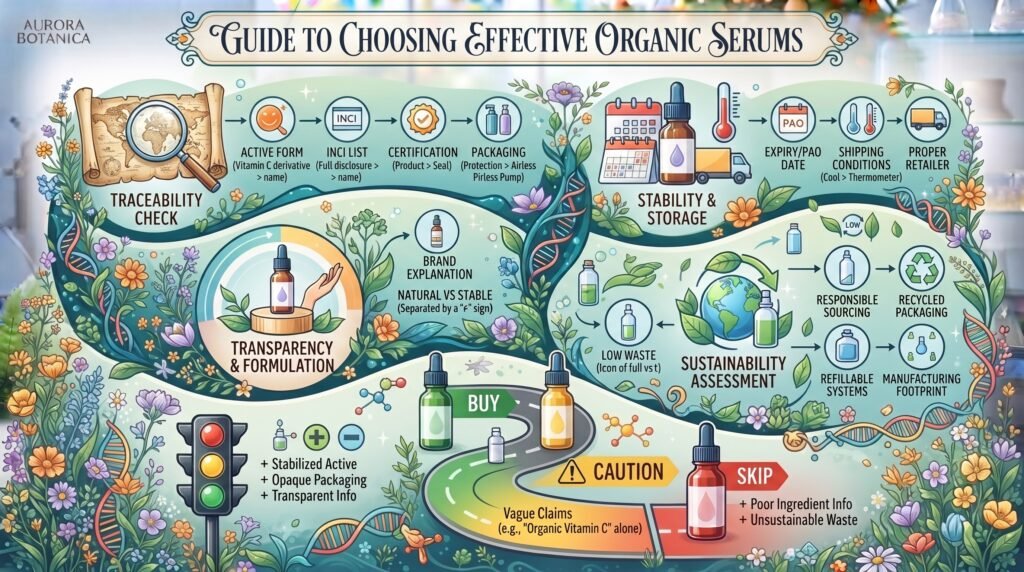
How to Choose an Organic Serum Without Wasting Money
Use this 10-point checklist before buying:
- Identify the exact active form. “Vitamin C” is not enough information.
- Check the INCI list. Look for the actual ingredient name.
- Verify certification. Don’t confuse “organic ingredients” with certified organic finished products.
- Inspect the packaging. Sensitive ingredients deserve appropriate protection.
- Check expiry and PAO information.
- Buy from authorized retailers whenever possible.
- Consider shipping conditions. This is especially important in hot climates.
- Look for formulation transparency. A serious brand should be able to explain what active form it uses.
- Don’t equate natural with stable.
- Don’t pay a premium simply because “organic” is printed on the front.
Organic Serums and Sustainability
Stability has an environmental dimension that is often overlooked. If a sensitive serum degrades prematurely, the consumer may discard:
- the remaining product
- the bottle
- the packaging
- the resources used to manufacture it
- the energy used to ship it
A stable product that is actually used completely can potentially reduce this kind of avoidable waste. But sustainability is broader than stability. Evaluate:
- Organic agricultural sourcing
- Responsible botanical harvesting
- Packaging weight
- Recycled materials
- Refillable systems
- Concentrated formulas
- Manufacturing footprint
- Shipping distance
- Packaging recyclability
- Product wastage
Do not automatically assume that an organic serum has a lower carbon footprint. A lightweight conventional product with efficient manufacturing and minimal packaging can sometimes have a different environmental profile from a heavier certified-organic product shipped across continents. Sustainable beauty requires a whole-system assessment.
The Same Rule Applies Across Clean Beauty
Whether you are buying Korean Beauty, an Organic Foundation, Organic Lipstick, Organic Makeup, Natural Makeup, or an organic skincare serum, the same principle applies:
Evaluate the complete formula, not just the marketing language on the front label. “Clean,” “natural,” “organic,” “non-toxic,” “vegan,” and “cruelty-free” can all convey useful information, but none of them automatically answers the formulation-stability question. That is why serious clean beauty should combine ingredient transparency with formulation science.
Quick Buy-or-Skip Guide
| Serum situation | Verdict |
| Stabilized active + protective packaging + transparent formulation | BUY |
| Sensitive active + credible manufacturer information + good packaging | CONSIDER |
| “Organic vitamin C” with no exact active form | CAUTION |
| Highly sensitive active in clear, highly exposed packaging | CAUTION |
| No meaningful expiry/storage information | SKIP |
| Strong marketing claims but poor ingredient transparency | SKIP |
| Certified organic + clearly designed formulation | STRONG OPTION |
Final Verdict
| Category | Best choice/strategy |
| Most important vitamin C factor | Correct active form + appropriate stabilization |
| Best packaging for sensitive actives | Airless or opaque protection |
| Biggest consumer mistake | Buying based only on “organic” |
| Best way to assess a serum | Active + formula + packaging + storage |
| Best sustainability strategy | Buy effective products and use them completely |
| Biggest red flag | Unsupported potency claims |
There is no single “best” vitamin C, retinoid or organic serum. The best product is the one in which the active form, concentration, formula, packaging, and storage conditions work together.
A stabilized derivative may make more sense than raw L-ascorbic acid for one product. A carefully formulated L-ascorbic acid serum may be the better choice for another. The label alone cannot tell you which one wins.
Conclusion: Organic Does Not Mean Stable
The clean-beauty industry has made ingredient sourcing a major part of the buying decision. That is valuable, but it is only half the equation.
An organic or natural serum is only as useful as the formulation protecting its active ingredients. Before buying, look beyond:
- Attractive packaging
- Influencer recommendations
- “Clean” labels
- “Natural” claims
- “Organic” marketing
Instead, ask: What is the active form? How stable is it? What protects it from oxygen and light? Is the packaging appropriate? Does the brand disclose meaningful formulation information? Is the organic claim independently certified? How sustainable is the complete product—not just its botanical ingredients?
The strongest clean-beauty products bring these elements together: skin science + formulation chemistry + ingredient transparency + responsible sourcing + environmental responsibility.
That is the real meaning of sophisticated organic skincare. “Organic” tells you something about sourcing or certification. It does not, by itself, tell you whether a fragile active remains effective once the serum reaches your skin.
Related Guides
Organic Concealer Guide: Can One Fix Both Under-Eyes and Blemishes?
Best Certified Organic Korean Skincare-Makeup Hybrids [2026 Guide]
Organic Foundation Guide 2026: Find Your Perfect Match
How to Choose Organic Lipstick: A Shade-by-Shade, Ingredient-by-Ingredient Guide
10 Proven Ways to Reduce Your AC Energy Bills in the GCC

10 Best Passive Cooling Techniques for GCC Homes