How Melting Glaciers Threaten Water, Livelihoods, and Our Future
The world’s glaciers are natural water banks: they lock winter snowfall as ice and release steady melt in summer to feed rivers, farms, and hydropower. But those banks are draining fast. New community-wide estimates show mountain glaciers lost roughly 6,542 billion tons of ice between 2000 and 2023, an average loss of nearly 273 billion tons per year, and that the melt rate accelerated by about 36% between 2000–2011 and 2012–2023. This loss has already contributed roughly 18 mm to global sea level and is reshaping freshwater availability for millions. Nature
Table 1: Global Mass Loss between 2000 and 2023 Data source
| Metric | Year | Value in billion tons |
| Total mass loss | 2000 – 2023 | 6,542 billion tons |
| Mean annual mass loss | 2000 – 2023 | ~273 billion tons per year |
| Annual loss | 2000 – 2011 | ~231 billion tons per year |
| Annual loss | 2012 – 2023 | ~314 billion tons per year |
Based on a study, the total loss of glacier mass from 2000 to 2023 contributed to around 18mm of global sea-level rise. ESA
Table 2: Change in Regional Glaciers since 2000 Data source
| Region | Estimated Regional Changes since 2000 |
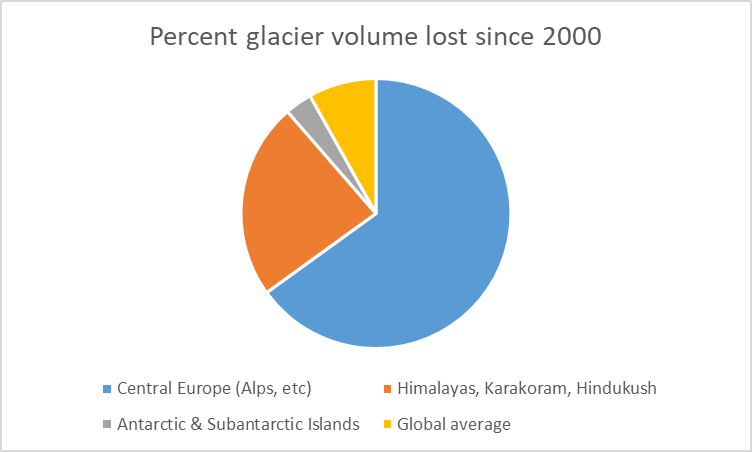
| Central Europe | Nearly 39% mass loss. |
| Hindu Kush–Himalayas | Loss rate increased by nearly 65% between 2011 and 2020 vs. 2000 and 2010 |
| Polar & subpolar islands | Nearly 2% mass loss. |
| Alaska & western North America | Nearly 30% mass loss |
Table 3: The key glacier/ice regions. Data source
| Region / Country | Character of glaciers | Typical scale | Role |
| Hindu Kush, Himalaya (Pakistan / India / Nepal) | High-altitude valley & plateau glaciers feed major Asian rivers such as the Indus, Ganges, Brahmaputra, and Mekong. | Critical headwaters for ~2 billion people | High exposure to glacial lake outburst floods |
| Patagonia (Chile / Argentina) | Temperate outlet glaciers and icefields (Southern Andes). | Key freshwater & hydropower sources | Rapid retreat in recent decades |
| Alaska & Western Canada | Large mountain glaciers and icefields. | Major contributors to global glacier mass loss | It has a substantial impact on sea levels |
| Greenland margins | Ice-sheet outlet glaciers | Greenland ice sheet loss | It is the dominant driver of sea-level rise |
| European Alps / Central Europe | Low-elevation alpine glaciers. | High percentage decline in small glaciers | Significant impacts on major tourism & water supply |
Table 4: Contribution to Global Sea Level Rise due to glacial loss. Data source 1 | source 2
| Period | Sea-level rise (millimeters) | Mass loss source |
| 2000 to 2023 | Nearly 18.0 mm | Mountain glaciers, excluding large ice sheets. |
| 1976 to 2024 | Nearly 25.3 ± 1.7 mm | By glaciers and ice caps, excluding large ice sheets. |
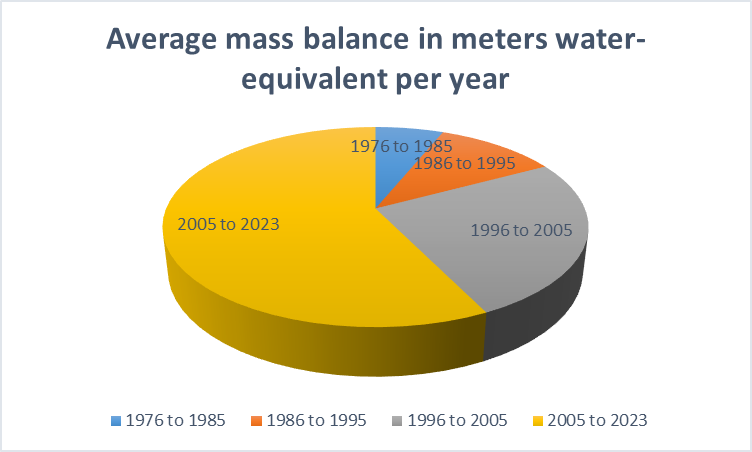
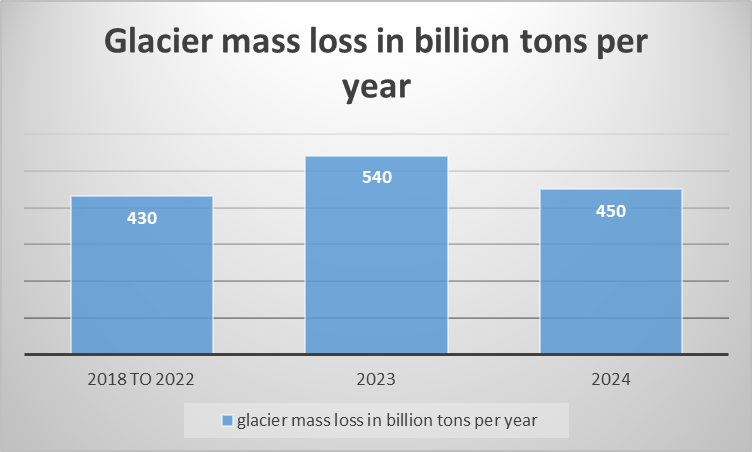
The year 2024 alone has a drastic melt of 450 billion tons of ice. The flooding affects around 200k to 300k people each year due to a single millimeter rise in the sea level. Data source
Why is intensity increasing
The severe impacts of global warming at high elevations and in maritime climates drive stronger surface melt and more frequent extreme melt years. Debris cover, black carbon, and altered precipitation patterns also impact glacier mass balance. The scientific data is obvious under higher emissions scenarios, many mountain glaciers will lose a significant fraction of their volume by 2100; under strong mitigation, the losses are minor but still substantial. IPCC
The glaciers are highly sensitive to climate change, and their melting clearly illustrates the impact of ongoing global warming. The melting of glaciers causes a global rise in sea levels, depletes freshwater resources, and rapidly increases the risk of local hazards. Therefore, it is essential to monitor glaciers to understand the impacts of global warming and to accurately project future sea-level rise and freshwater availability.
Immediate actions
- It is essential to expand a robust satellite imagery and field monitoring system to track the annual melt of ice. Artificial intelligence can be utilized to collect real-time data to target high-risk glaciers and ice sheets.
- Glacial lake outburst floods are capable of releasing hundreds of thousands of cubic meters of water in a short span and have disastrous effects on villages and infrastructure. High-risk lakes and glacial lake outburst flood areas should be continuously monitored to ensure their safety. Automatic early warning systems, sensors, and sirens should be installed to alert communities and facilitate emergency preparedness and response.
- South Asian nations largely depend on melting glaciers for irrigation purposes, and a reduction in flow will threaten food security in the future. Drip and sprinkling water systems must be installed to efficiently utilize water for irrigation purposes in agricultural areas, thereby reducing evaporation, minimizing water misuse, and enhancing groundwater recharge.
- Climate-sustainable designs can save billions of dollars; traditional engineering designs, which rely on historical data, are of limited use in modern engineering. It is vital to redesign roads, bridges, dams, and power plants by maintaining a factor of safety (FOS) of at least three times in high-risk areas to resist damage from future floods and debris flow events.
- Countries dependent on glaciers, such as Pakistan, Nepal, Peru, and Bhutan, have a minor to no contribution to global emissions but are experiencing significant impacts from glacier melting. High-emissions and wealthier nations must compensate for resilient projects, adaptation, loss, and damage through an international funding mechanism that supports local monitoring, resettlement, and technology transfer for early warning systems.
Related Guides
Hidden Toxins in Synthetic Cosmetics You Must Avoid

10 Frequently Used Plastic Bathroom Swaps for an Eco-Friendly Home

10 Frequently Used Plastic Items Swaps for a Sustainable Kitchen

Plastic Is Dying: These 10 Packaging Alternatives Are the Future
6 Revolutionary Plastic Alternatives in 2026 to Replace Traditional Plastic
9 Affordable Green Technology Products to Reduce Energy Consumption in 2026

A very powerful article It shows how fast glaciers are melting and how our environment is changing. It really makes us think about how important it is to protect our Earth before it’s too late. 🌿
It’s an amazing article glacier are the most important source of water and day by day climate changes inthe form of cloud brust r heigh sea level this information is new for me nd this is so interesting we all play our role to improve our environment ❤️
After reading this, I realized climate change is not just a global issue but a personal responsibility. Each of us must contribute to saving our.
It highlights how global warming is severely affecting glaciers. Awareness and practical actions are the need of the hour.
Additionally this article shows that AI and innovation are key to fighting climate change. With the right use of technology, we can protect both our glaciers and our environment.
This article is definitely worth reading. It provides detailed data and global comparisons showing how rapidly glaciers are melting and how that affects water supply, livelihoods, and rising sea levels. It’s informative and raises awareness about the urgent impacts of climate change on our planet’s future
This article made me realize that climate change is everyone’s responsibility. Global warming is melting glaciers fast, so awareness and action are urgent. It also shows that AI and innovation can help protect our planet and its glaciers.
This well-researched article effectively highlights the rapid loss of glaciers and its significant impact on global water security and sea-level rise. Its focus on data-driven monitoring, sustainable adaptation, and international responsibility offers a valuable perspective on climate change.
After reading this article, I’ve come to realize that climate change is not merely a global concern – it is a personal responsibility that requires action from each of us. The article vividly explains how global warming is accelerating the melting of glaciers, leading to rising sea levels and threatening ecosystems around the world. It emphasizes that awareness alone is not enough; what we truly need are practical, everyday actions to reduce our carbon footprint and protect our planet.