Understanding cloudbursts is increasingly essential in today’s world, as climate change and human activity intensify the frequency and severity of these extreme rainfall events.
What Exactly is a Cloudburst?
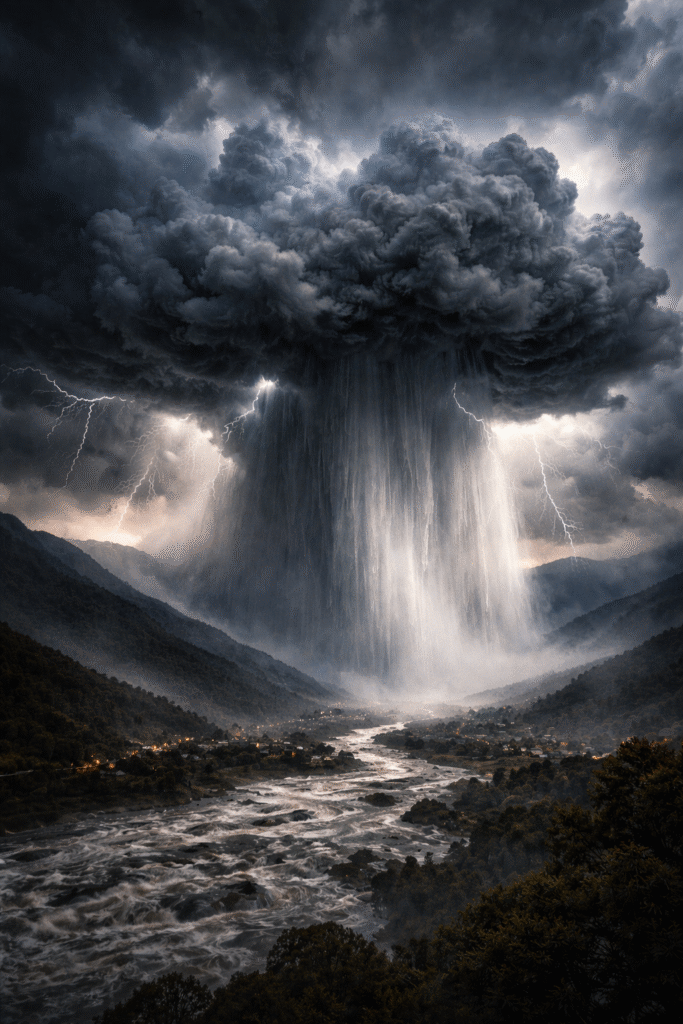
The term cloudburst is used because the rainfall resembles a sudden burst of water from the sky. When it rains aggressively over a short period of time in a particular area, e.g., 100mm/hr in a 20-30km square, it’s called a cloudburst. They can be really dangerous, leading to destructive flash floods and landslides. Thunderstorms push large amounts of warm, moist air upwards, forming giant, dense clouds of water droplets and ice particles. This upward pressure even prevents the drops from falling. But when the clouds can’t hold the water any longer, they explode, releasing intense rainfall over a concentrated area. That’s why cloudbursts are also called water bombs.
Unlike the widespread and prolonged seasonal monsoon rains, cloudbursts are highly localized. The rainfall rate is so extreme that rivers, streams, and urban drainage systems are unable to cope with the sudden surge of water, resulting in flash floods.
Why Do Cloudbursts Occur in Mountainous Regions?
Mountains are especially prone to cloudbursts because of a process known as orographic lifting. When moist air collides with a mountain slope, it is pushed upward. As air rises and mixes with surface heat, thunderstorms build more quickly and with greater intensity. This chain of events often results in powerful storms that produce heavy rainfall over a short period.
In the Himalayas, for example, cloudbursts have caused devastating floods and landslides that destroy villages, roads, and agricultural land within minutes. With climate change, wet monsoons have also become heavier in nearby regions, such as Pakistan. The steep terrain allows water to flow downhill at great speed, while loose soil and deforestation worsen the damage.
The Connection among Cloudbursts, Flash Floods, and Landslides
The intensity of cloudbursts is associated with multiple hazards.
Flash Floods
Rivers and drainage channels cannot accommodate sudden surges of water, leading to flooding within minutes, especially in urban areas and narrow valleys.
Landslides
Deforestation plays a significant role in increasing vulnerability. Trees typically hold the topsoil together with their roots. When forests are cleared, the soil becomes less stable. Heavy rain then washes away the loosened soil, triggering landslides that can bury homes, roads, and farmland.
Together, these impacts make cloudbursts one of the most destructive forms of extreme weather, particularly in fragile ecosystems and densely populated regions.
Global Warming and the Rise of Extreme Rainfall
- The likelihood of cloudbursts is increasing worldwide due to climate change. The warm atmosphere can hold more moisture. When water vapor condenses in the atmosphere, it produces much heavier rainfall than usual. A slight rise in global temperatures can increase the air’s ability to store moisture, leading to more frequent and intense downpours.
- On a regional scale, urban areas exacerbate this challenge. Concrete tends to absorb and retain heat. It is frequently used in cities to build high-rise structures, which causes the urban heat island effect. Likewise, routine human activities, such as energy consumption, vehicle emissions, and industrial processes, release heat and pollutants, further intensifying the likelihood of extreme rainfall events.
- Pollutants act as condensation nuclei, encouraging the formation of rain-bearing clouds. Together, these factors increase the likelihood of heavy rain in large metropolitan areas, often overwhelming drainage systems and leading to urban flooding.
Why Are Cloudbursts Hard to Predict?
Forecasting cloudbursts remains one of the biggest challenges for meteorologists. There are two main reasons for this difficulty:
Randomness of occurrence
Cloudbursts are highly localized and can form suddenly, making them unpredictable using traditional weather models.
Limited knowledge of atmospheric processes
While scientists understand the general mechanisms, the exact sequence of events leading to extreme rainfall remains under study.
Most weather centers rely on nowcasting for short-term predictions. It involves monitoring current weather patterns, radar imagery, and satellite data to predict conditions for the next few hours. While this approach can provide some warning, it is still not precise enough to forecast the exact timing and location of a cloudburst.
Preparing for the Future: Strategies to Reduce Risk
It is expected that the frequency of extreme rainfall events will increase as climate change intensifies; therefore, proactive strategies are crucial.
- Planting trees helps stabilize soil and reduce the risk of landslides. Sustainable urban water management systems, such as restoring wetlands, green spaces, and water retention structures, can help manage sudden rainfall. Expanding the use of radar, satellites, and AI-driven weather models can enhance short-term predictions and emergency preparedness. Educating people in vulnerable regions about evacuation plans and safety measures can save lives during flash floods.
- Cloudbursts are triggered by thunderstorms, orographic lifting, and other climatic factors, unleashing massive volumes of rain over a short period. The consequences—flash floods, landslides, and urban flooding are often catastrophic, particularly in mountainous regions and densely populated cities.
- With global warming increasing the likelihood of such intense weather events, it is essential to adopt a combination of environmental conservation, scientific innovation, and contingency planning.
- Extreme rainfall events are becoming increasingly frequent. Understanding cloudbursts is not just a scientific necessity but a critical step toward protecting lives, livelihoods, and ecosystems.
Related Guides
10 Frequently Used Plastic Bathroom Swaps for an Eco-Friendly Home

Safer Swaps of 10 Frequently Used Plastic Kitchen Items

Plastic Is Dying: These 10 Packaging Alternatives Are the Future

6 Revolutionary Plastic Alternatives in 2026 to Replace Traditional Plastic

9 Affordable Green Technology Products to Reduce Energy Consumption in 2026

How Fog Harvesting Is Redefining Water Security

Very informative! 🌧️ I didn’t realize how quickly cloudbursts could lead to flash floods. Climate change is really making weather events more unpredictable.
This article gives a very clear and informative explanation about cloudbursts and their dangerous effects on nature and human life. It shows how sudden heavy rain can cause floods, landslides, and great damage to communities. I really like how the article connects cloudbursts with climate change and explains the need for awareness and safety measures. It reminds us that understanding nature and protecting our environment is very important to prevent such disasters in the future. A very well-written and meaningful article that spreads awareness and knowledge in a simple way.
The article provides practical steps to prepare for and mitigate the impact of cloudbursts, a crucial topic for regions prone to such extreme weather events. From early warning systems to flood-resistant infrastructure, the suggestions are valuable for individuals, communities, and policymakers alike.