In a world facing intensifying droughts, shrinking aquifers, and growing populations, conjuring water out of thin air once seemed like science fiction. Yet in sun-baked deserts and fog-shrouded coasts, communities are doing precisely that: harvesting freshwater directly from fog. This unassuming yet powerful technology, rooted in simple physics and community ingenuity, is helping redefine water security, strengthen water efficiency, and sovereignty for regions that have long struggled with scarcity.
In this article, you will discover how fog harvesting is redefining water security. Fog harvesting is not a high-tech dream of the distant future. It is a cost-effective, locally deployable, energy-free solution being used today to deliver drinking water, improve agriculture, and support resilient livelihoods in some of the planet’s harshest environments.
What Is Fog Harvesting? A Simple Technology with Deep Potential
At its core, fog harvesting captures moisture suspended in the air as tiny droplets and converts it into liquid water for storage and use. Unlike rainwater harvesting, which depends on precipitation, fog harvesting taps into atmospheric moisture, especially valuable in regions where precipitation is almost nonexistent, but fog events are frequent.
The basic setup is deceptively simple:
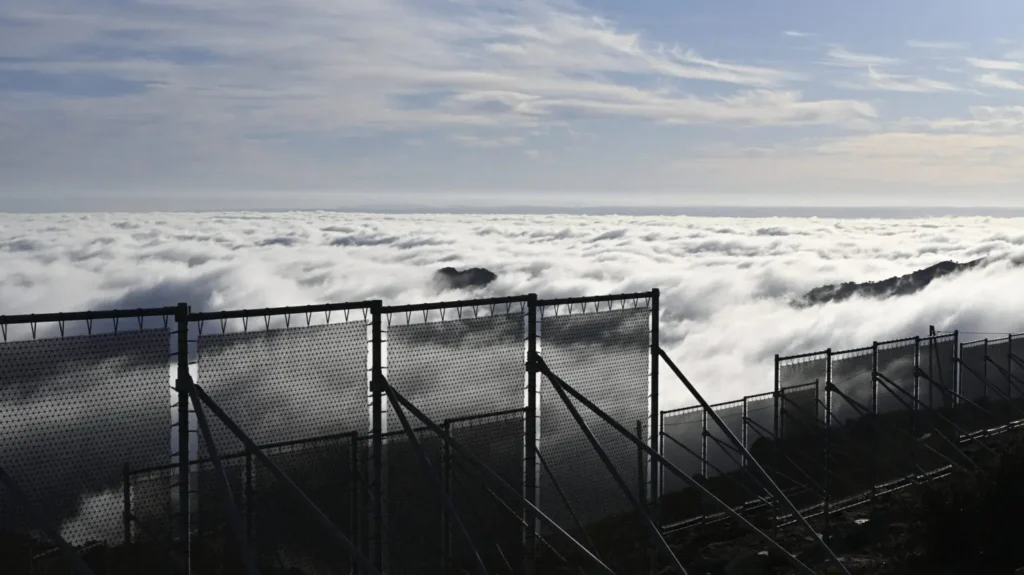
- Mesh nets made from materials such as polypropylene or specialized meshes are suspended vertically on sturdy frames.
- As fog passes through the nets, its tiny droplets collide with the fibers and coalesce into larger droplets.
- These larger droplets then drip down into gutters and are collected in storage tanks for later use.
Because this process requires no electricity and little maintenance, it is especially suitable for off-grid, rural, and under-resourced communities.
A Rising Tide of Hope in Water-Scarce Landscapes
Chile’s Atacama Desert: Farming the Fog
The Atacama Desert, one of the driest places on Earth, with parts receiving less than a millimeter of rain annually, is an unlikely setting for agriculture. Yet along its coastal ranges, dense fog known as camanchaca offers a lifeline.
Local innovators, including the Atacama Fog Catchers Association, have installed mesh fog nets suspended between poles to capture this moisture. In some installations, they’ve collected between 1,000 and 1,400 liters of water in arid areas without sustainable water sources. That water is stored and used for hydroponic cultivation of lettuce and lemons, turning barren sand into productive green fields. REUTERS
This approach offers multiple benefits: it provides drinking water, supports food production, and increases community autonomy, without depending on distant aquifers or energy-intensive desalination.
Morocco’s Anti-Atlas Mountains: Community Water Sovereignty
In southwest Morocco, fog harvesting has transformed lives in remote villages perched on the edge of the Sahara. Here, the Dar Si Hmad nonprofit installed large mesh fog collectors that capture up to 6,000 liters of water per day, enough to supply clean drinking water directly to households. Before the project, residents walked for hours every day to fetch water from unreliable sources. CNN
For these communities, fog harvesting is more than just a water supply: it is a tool of empowerment, enabling local stewardship of a resource that would otherwise be inaccessible.
Eritrea and Tanzania: Schools and Villages Reimagined
Fog harvesting has also taken root in East Africa. In the Eritrean highlands, initial fog nets were installed in the early 2000s, providing essential water in villages perched above 2,000 meters. In Tanzania, systems known as Cloud-Fishers supply fresh drinking water to dozens of schools, reducing students’ time spent on water collection and improving attendance and health. WASSERSTIFTUNG
These real-world implementations demonstrate how straightforward mesh systems, grounded in local participation and simple materials, can meet vital social infrastructure needs.
Cost-Effectiveness: A Big Advantage for Small Communities
One of fog harvesting’s greatest strengths is its affordability.
- Small experimental setups can cost as little as $75 to $200 USD, ideal for pilot or household systems.
- Larger community systems with dozens of square meters of mesh typically range between $1,000 and $1,500 USD each, and can last a decade or more with basic upkeep.
- Village-scale installations producing thousands of liters per day may require a modest investment, e.g., ~$15,000 USD, yet deliver water without ongoing fuel or electricity costs.
Compared with desalination plants that require significant capital and high operating costs, or transporting water across long distances, fog harvesting levels the playing field. It brings independence, sustainability, and low financial barriers to water procurement.
The operating cost per liter of fog-harvested water is highly competitive, estimated at roughly $0.05 to $0.10 per liter in studies from Saudi Arabia’s Al-Baha region, making it practical even in tight budgets.
Beyond Drinking Water: Supporting Agriculture and Ecosystems
Fog harvesting’s potential goes well beyond potable water. When water is scarce, agriculture is often the first casualty. But fog collection can help sustain irrigation for gardens and crops, boosting food security and local incomes.
In Peru’s Bellavista region, fog collectors have provided enough water for villagers to plant gardens and cultivate tara trees, which produce tannins for leather treatment and help regenerate degraded landscapes.
Similarly, in Chile’s Atacama Desert, fog-derived water supports hydroponics, demonstrating that agriculture can thrive even where rain never falls.
By enabling local food production, fog harvesting strengthens community resilience and reduces dependency on imported food, another critical dimension of water sovereignty.
Design Innovations and Future Potential
While the basic fog net is simple, research continues to enhance efficiency and usability.
Innovations include:
- Improved mesh materials that better capture droplets and shed water quickly.
- Surface designs inspired by desert plants that enhance fog interception.
- Multi-layer fog collectors that boost throughput without increasing footprint.
Such advancements point to even greater yields and broader applicability. There is also growing interest in integrating fog harvesting into building designs by embedding mesh into façades to collect water for irrigation and other uses in coastal cities.
Challenges and Limitations
Fog harvesting is not a universal solution. Its effectiveness depends on local climate conditions: sufficient fog frequency, wind patterns, and positioning are crucial. In desert interiors with low air moisture, fog nets yield minimal water.
Additionally, while studies show that fog water can meet drinking standards, proper handling, storage, and hygiene practices are essential to ensure safety.
Maintenance, such as cleaning nets and clearing debris, is modest but requires community organization and training. However, this can be a strength, as it builds local capacity and ownership over water systems.
Toward True Water Sovereignty
Water sovereignty, community control over water resources, is more than a technical challenge. It is about dignity, autonomy, and the right to thrive without dependence on external support.
Fog harvesting empowers communities to define their own water futures. Rather than relying on distant reservoirs or energy-intensive infrastructure, villages in Morocco, highland towns in Eritrea, and remote regions of Chile are taking control of their water supply using local knowledge, simple materials, and cooperative action.
For many arid and coastal communities, fog harvesting is not just a supplemental water source; it is a transformative force that supports health, livelihoods, and the stewardship of local environments.
Conclusion: A Clearer Path Through the Mist
From the fog-shrouded peaks of the Anti-Atlas to the windy slopes above the Atacama, fog harvesting stands as a testament to human ingenuity and resilience.
It shows us that even in the most inhospitable landscapes, nature offers solutions if we learn to listen and adapt.
By turning desert air into drinking water, fog harvesting is redefining what water security looks like in the 21st century: not as a distant dream powered by megaprojects, but as a locally grounded, sustainable reality where communities draw water from the very air around them.
Related Guides
10 Frequently Used Plastic Bathroom Swaps for an Eco-Friendly Home

Safer Swaps of 10 Frequently Used Plastic Kitchen Items

Plastic Is Dying: These 10 Packaging Alternatives Are the Future

6 Revolutionary Plastic Alternatives in 2026 to Replace Traditional Plastic
9 Affordable Green Technology Products to Reduce Energy Consumption in 2026

Does Fast Fashion Cause Pollution

A beautiful reminder that nature already has solutions for us. 💌